Tummy time trackers
Four free printable tummy time trackers for the first few months, with somewhere to note the position, how long you managed and whether anybody enjoyed it. Blue, pink, illustrated and a plain ink-light version.
Also known as: tummy time chart, tummy time log, tummy time record sheet, baby development tracker.
What’s actually on the sheet
A week of rows, four per day, with space for the time, how long you managed, which position you used and how it went. Underneath there’s a summary box for the week, and a list of positions and activities for the days when your brain has gone completely blank.
I wrote that list for myself first, and it’s the part most people end up using. At half past four on a Tuesday, nobody remembers that a mirror exists.
How long a session should be, and how that changes
This is the question the sheet quietly raises, because once you start writing durations down you want to know what a good one looks like.
NHS advice is to start soon after birth and keep it little and often, building up gradually rather than aiming at a number. In the first few weeks, NHS services suggest one to two minutes at a time. From there you build towards roughly ten to fifteen minutes, several times a day.
So the early rows on your sheet are supposed to say things like “40 seconds” and “1 min, cried”. That isn’t a slow start, that’s the start. The rows get longer on their own as the neck and shoulders get stronger, and the jump usually happens somewhere you weren’t watching for it.
The daily total most people have heard of, and where that figure comes from, is in the tummy time guide, along with what to do when none of it is going well.
The two rules worth knowing
Tummy time is awake time, and it’s supervised time. Every session happens while you’re watching, and babies still go on their backs to sleep, every nap and every night. If your baby drops off mid session, that’s your cue to move them.
Everything else is negotiable.
Setting up a tummy time spot
Choose a firm, flat surface on the floor, such as a play mat or a blanket on a hard floor. Avoid a bed, a sofa or a raised changing surface, because a baby can roll off and tummy time should only happen where you can keep a close eye on them. Sit or lie on the floor beside them, within arm’s reach. Put one or two toys at face height, not in a pile to one side, so there’s something to look at and reach for.
If your baby loathes it
Welcome, there are a great many of us. A few things that tend to help:
Start on your chest rather than the floor. Lie back, put them on you, and let them look at your face. It counts, and it’s a much easier sell.
Pick your moment. After a nappy change is usually better than after a feed, and a grumpy baby isn’t about to be talked round.
Get down there with them. A face at floor level is more interesting than the entire contents of a toy box.
Keep it short and do it often. Three cheerful minutes spread across the day beats one grim ten minute stand off, and the sheet has four rows a day for exactly that reason.
A week in practice
Pick two fixed times a day, such as after a nappy change and after a nap, and do tummy time at those times. Short sessions done often are easier to fit in than one long session that gets skipped. Tick each row as you go, and look at the summary box at the end of the week to see how the longest session has changed.
Filling it in without losing the plot
Write it down at the time or not at all. Nobody reconstructs a Tuesday from memory on a Thursday, and a half filled sheet is still more use than a blank one.
The summary box at the bottom is there because progress in the early months is slow enough that you can’t see it day to day. Looking back at a week where the longest session went from forty seconds to three minutes is quietly encouraging, and there are weeks when you need that.
Using the sheet with a partner
If two adults share the care, agree on who does the tummy time each day, and write their initials on the row. The sheet then shows what has been done and by whom, which avoids two people doing the same session or neither doing it. A quick word at the handover is enough.
Reading your own sheet
A week that looks flat usually isn’t. Babies have off weeks, and a cold, a growth spurt or a run of bad naps will show up in these rows before it shows up anywhere else.
What’s worth noticing is the longest session rather than the average, because that’s where strength shows first. If the longest session hasn’t moved in three or four weeks, that’s not an emergency, but it is worth mentioning at your next contact with your health visitor.
Also look at which position you wrote down most often. If every row says chest, your baby is telling you the floor is still too hard, and there’s no hurry about it.
This sheet, or the daily log?
They look similar and they do different jobs. The newborn daily logs cover feeds, nappies and sleep, which is the information a midwife or health visitor asks about in the early weeks.
This one does tummy time only, in more detail than a daily log has room for, with the position and the response alongside the duration. Most people who use both keep the daily log going for a few weeks and this one for a few months, because tummy time carries on mattering long after you’ve stopped counting nappies.
When to ask someone who knows
If you have any worry about how your baby is moving, holding their head, or using one side more than the other, that’s a conversation for your health visitor or GP rather than a chart. Take the sheet with you if it helps, because it’s easier than trying to remember, but let them do the interpreting. That’s what they’re for and they have seen it all before.
Where this comes from
The session lengths above follow NHS guidance on keeping a baby active, at nhs.uk, and the tummy time advice from NHS Healthier Together, which is where the one to two minutes and the ten to fifteen minutes come from.
This is general information rather than advice about your baby. Your health visitor, family nurse, GP or midwife knows your child and this website doesn’t.
4 free tummy time trackers to print
Every sheet is a PDF sized for A4. Tap a design to download it. No sign-up, no watermark.
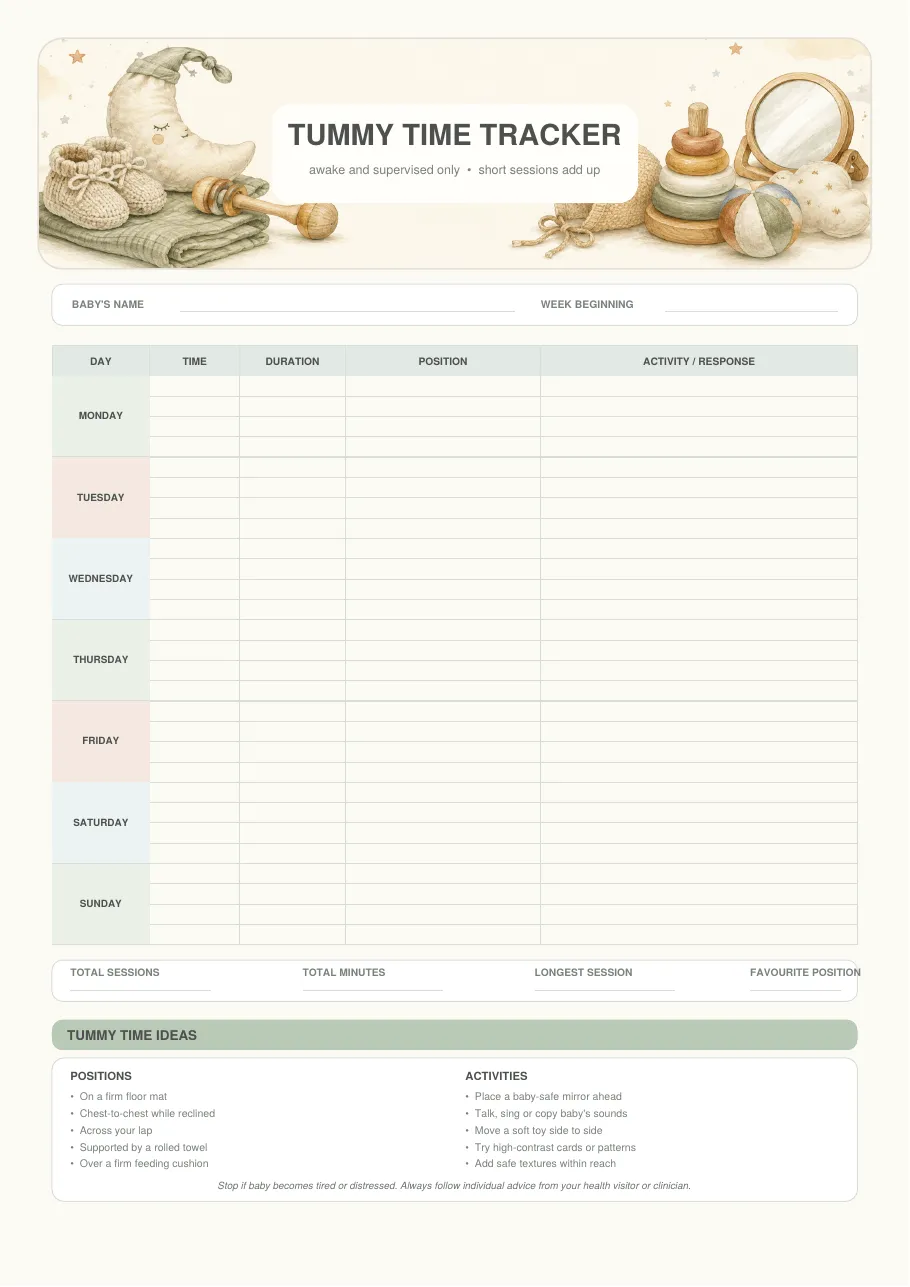
Illustrated tummy time tracker
The full watercolour version, with a sleepy moon, knitted booties and a stack of wooden rings. Soft neutrals throughout.
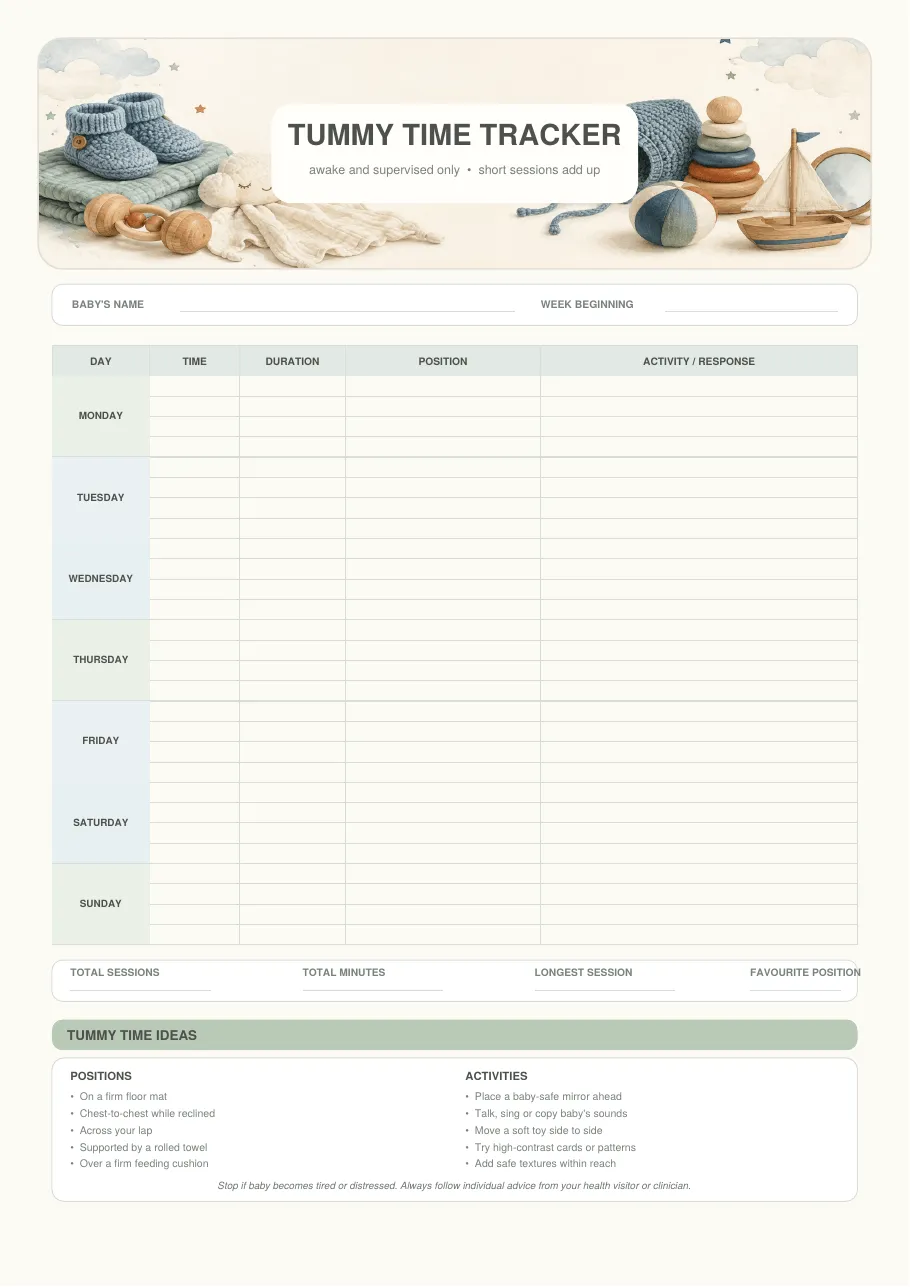
Blue tummy time tracker
Blue knitted booties, a little sailboat and blue and green day bands down the side.
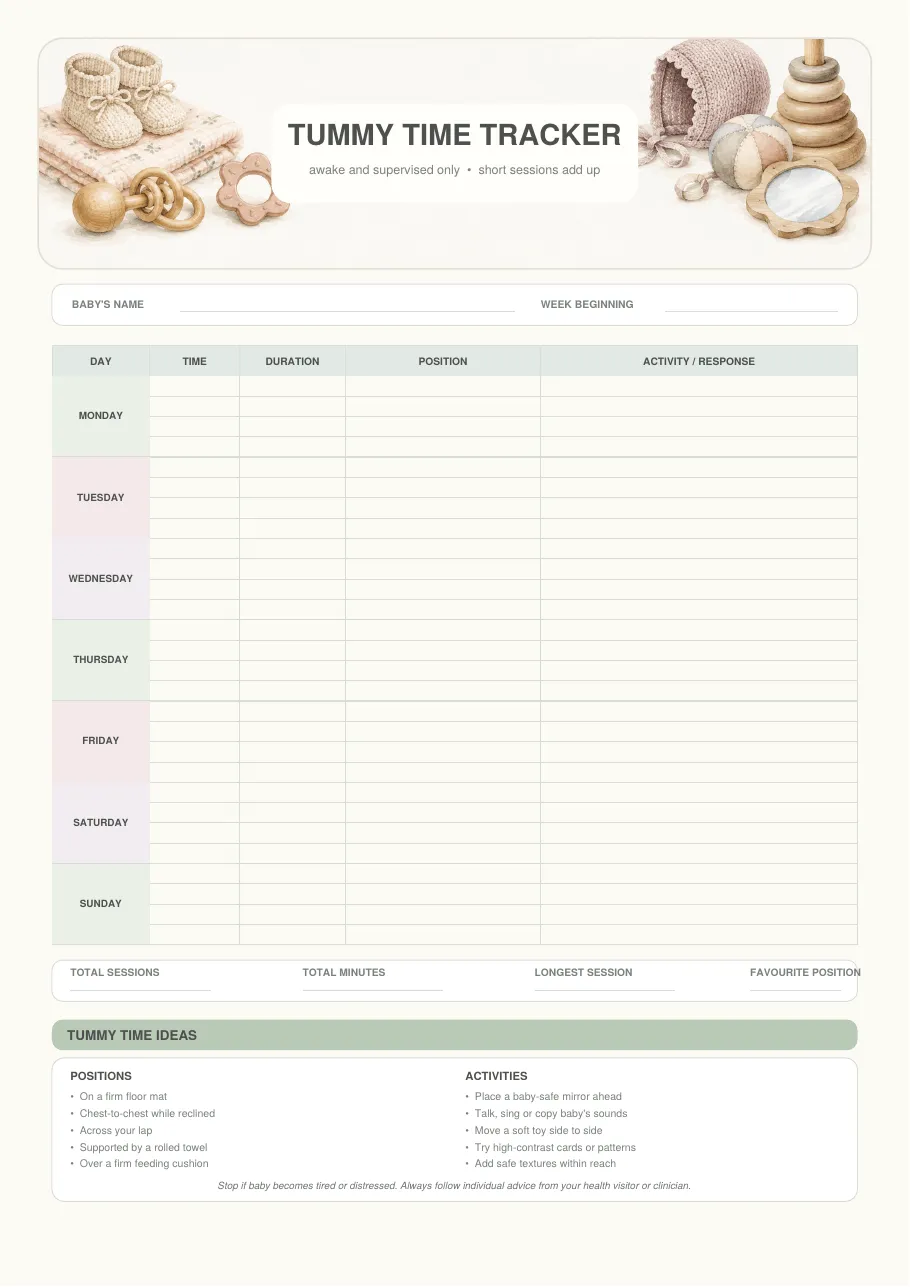
Pink tummy time tracker
Cream and pink, with a bonnet, a wooden rattle and a flower mirror. Same grid, different mood.
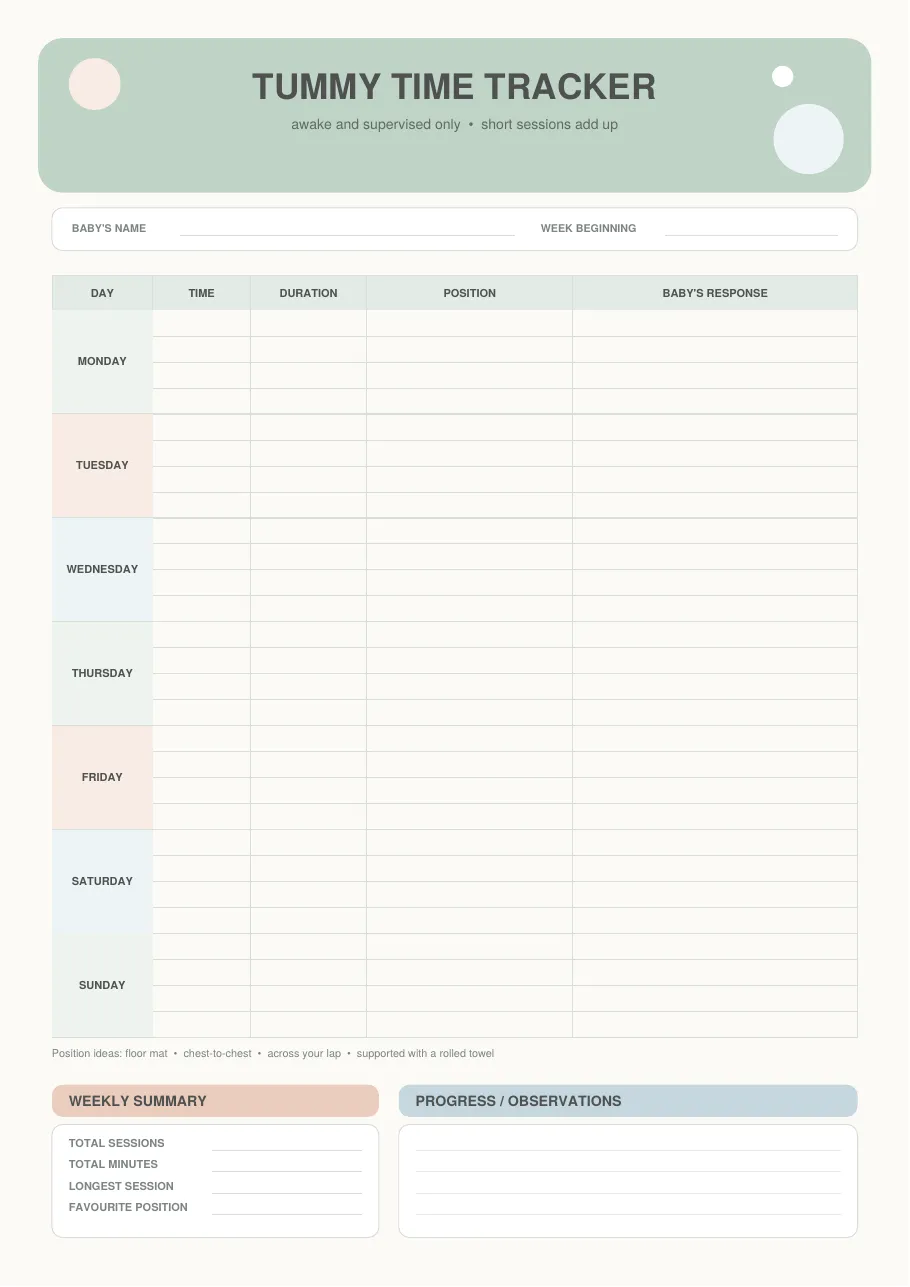
Plain tummy time tracker
No illustration, no shading, no colour worth speaking of. Prints in seconds and costs almost nothing in ink.
Printing a week at a time
- Portrait A4, one week per sheet. Print at 100 percent rather than "fit to page" so the writing rows stay big enough to actually write in.
- The plain version is the one to print if your ink situation is dire. It says exactly the same thing without the watercolour.
- Stick it wherever the mat lives. A tracker in the kitchen drawer records nothing.
Common questions
Do I actually need to track tummy time?
Not remotely. Some people love seeing it add up, some people find it one more thing to feel behind on. If you're in the second group, recycle the sheet with our blessing.
How long should each session be?
As long as your baby is happy, which in the early weeks might be under a minute. That's fine. Little and often is the whole trick, and your health visitor is the person to ask about what suits your baby.
My baby hates it. Am I doing something wrong?
No, and you have plenty of company. Try it on your chest instead of the floor, try it after a nappy change rather than after a feed, and get your face down at their level. Most babies object to the floor rather than the position.
Can I use this to log naps too?
Better to keep them separate. Tummy time is awake, supervised time only, and it helps to have a sheet that says nothing else. The daily log has room for sleep.
Read next
What a newborn can see, and what to do with it
What babies can see in the first months, how far away they focus, when eye wandering should settle, and the warning signs to raise with a health professional.
A parent's guide to tummy time
What tummy time is for, when to start, how much to aim for and what to do when your baby hates it. Based on current NHS and WHO guidance, written for people who are very tired.
Printables that go with these
 4 sheets
Newborn daily logs
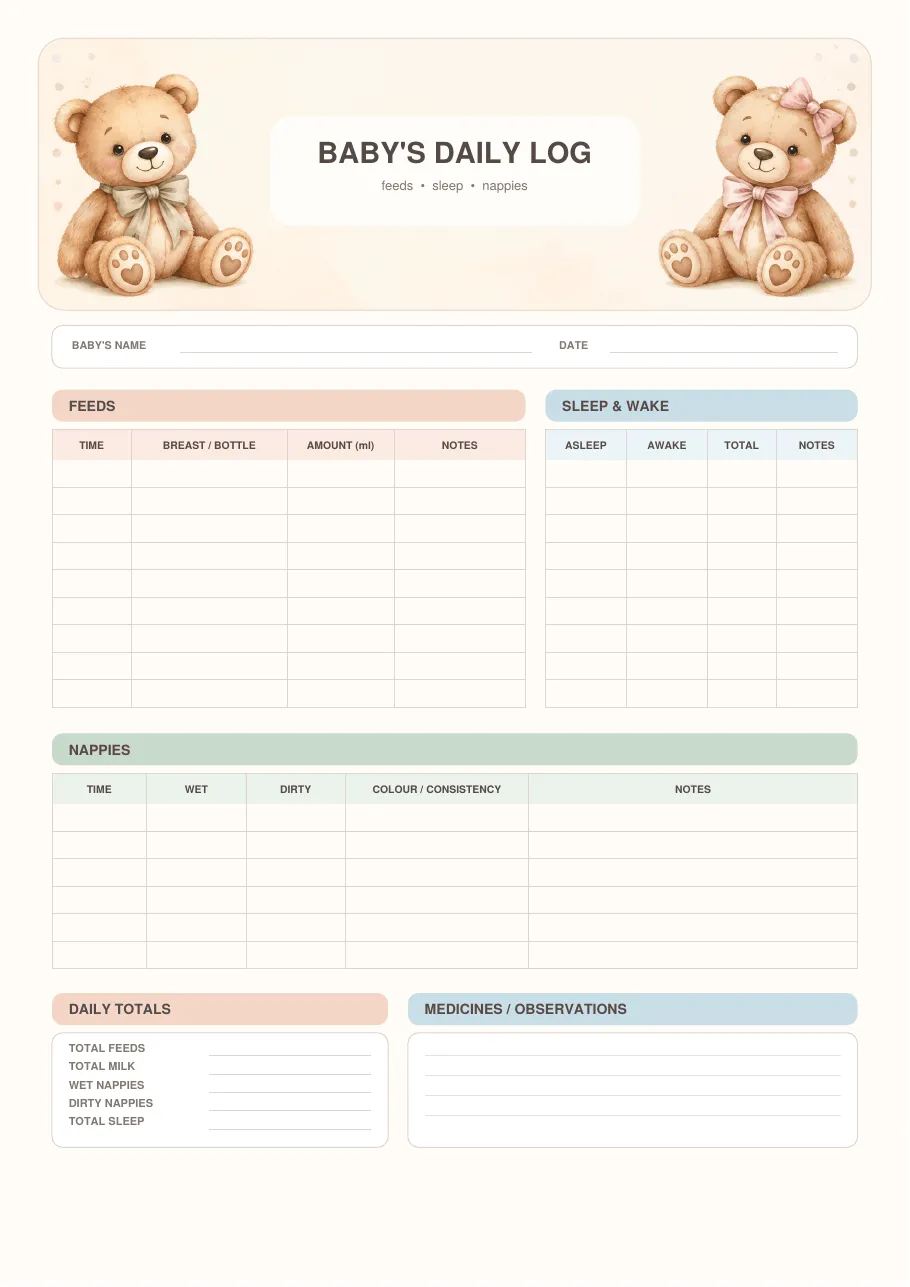
Four free printable daily logs for feeds, sleep and nappies, all on one A4 sheet. Teddies, elephants, wooden blocks or a plain version for when the ink is running low.
 1 sheet
High contrast baby cards
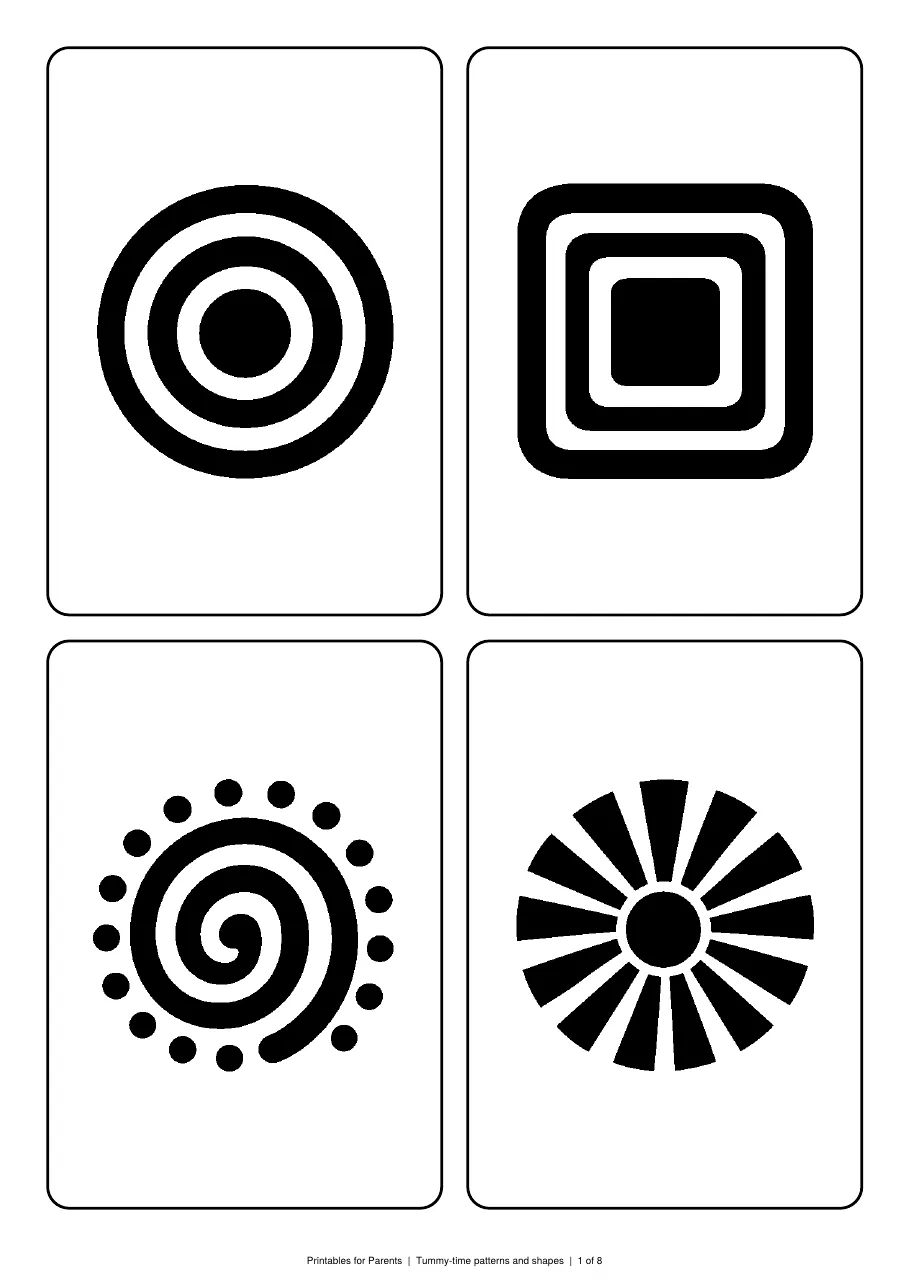
Thirty two free black and white cards for newborns, four to an A4 page, with patterns, shapes, faces and animals to prop up during tummy time or hold at the distance a new baby can actually focus on.
 1 sheet
First foods and allergen tracker
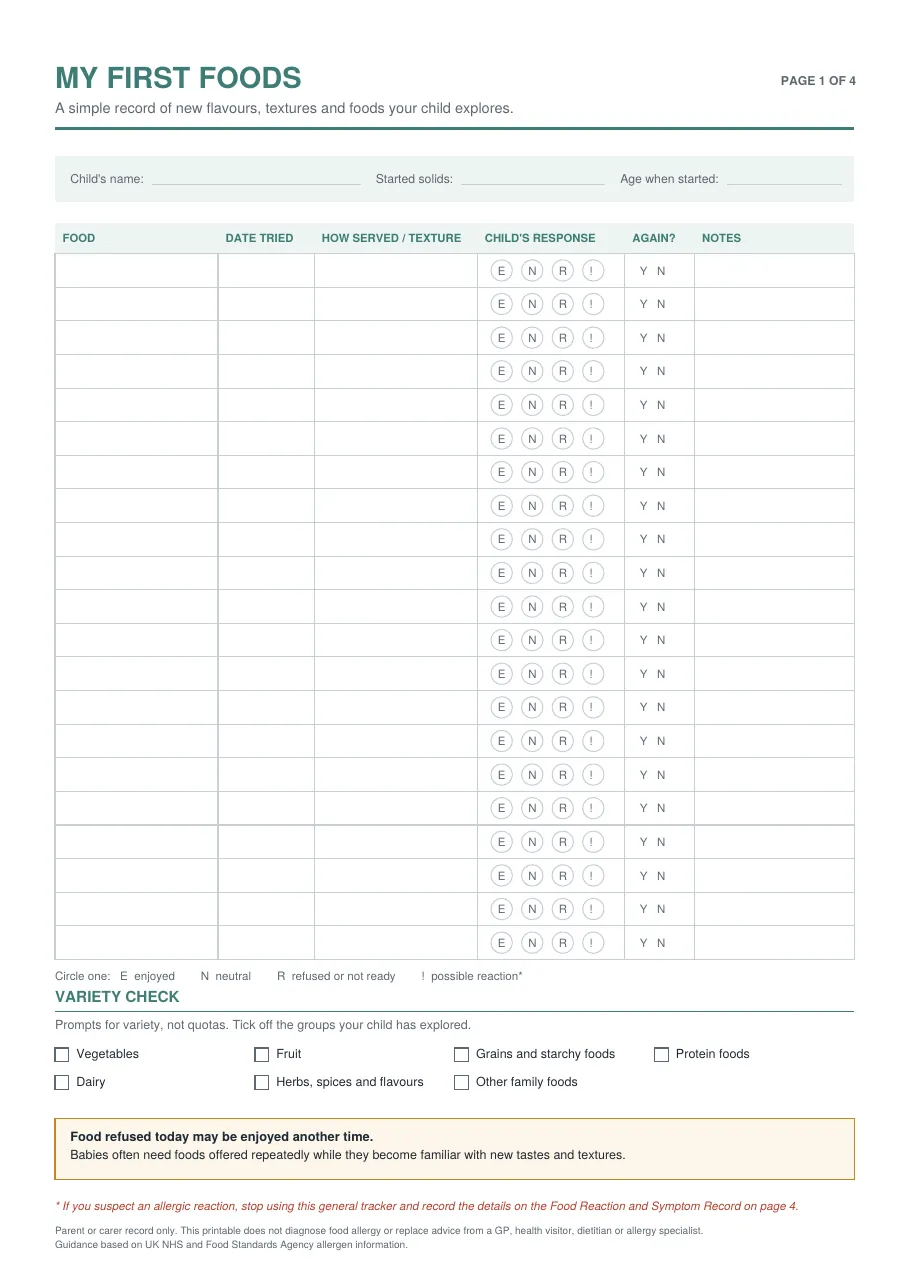
A free printable four page tracker for weaning. Somewhere to record new foods, a chart for introducing the UK 14 allergens, a page for keeping them in the diet afterwards, and a detailed reaction record to take to an appointment.
 1 sheet
Antenatal appointment planner
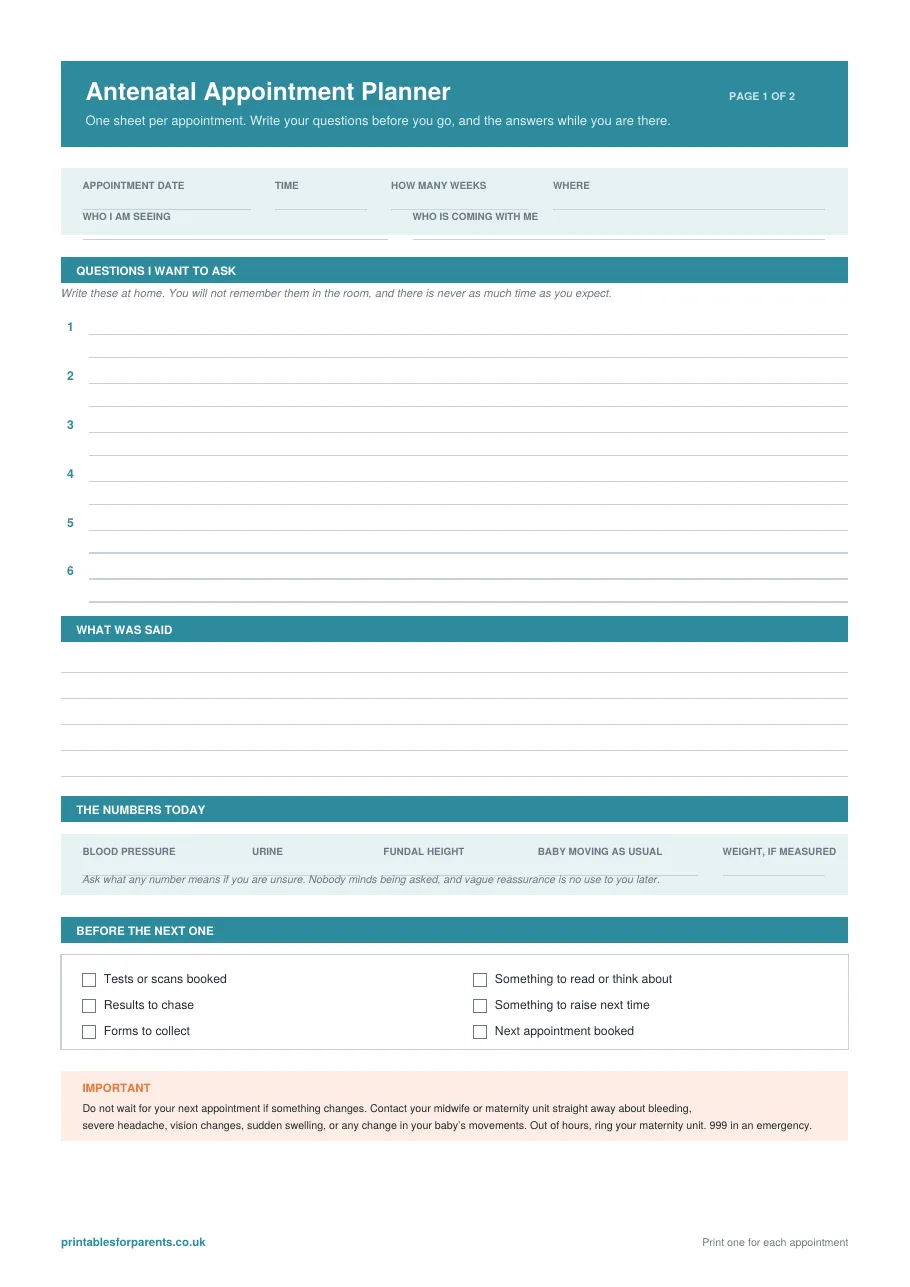
A free printable planner for your antenatal appointments. One sheet per appointment for the questions you meant to ask, plus a page holding the whole schedule so you can see what's booked and what isn't.