Newborn daily logs
Four free printable daily logs for feeds, sleep and nappies, all on one A4 sheet. Teddies, elephants, wooden blocks or a plain version for when the ink is running low.
Also known as: baby daily log, feeding log, nappy chart, newborn tracker sheet, breastfeeding log, baby log sheet.
What’s on the sheet
Feeds down the left with time, breast or bottle, amount and a notes column. Sleep and wake beside it. Nappies underneath, with room for the colour and consistency detail that you’ll never think you need until somebody asks you about it.
At the bottom there’s a totals box and a space for medicines and observations. The totals box is the bit that earns its keep at appointments, and it was the only part anybody ever actually looked at.
Why bother writing any of it down
Because you’ll be asked. Midwives, health visitors and GPs all ask about feeding and nappies in the early weeks, and almost nobody can answer accurately from memory on broken sleep. A sheet on a clipboard answers the question in two seconds and you get to look organised, which is a nice feeling when you’re wearing yesterday’s jumper.
There’s a quieter reason too. A night that felt like a catastrophe often looks completely ordinary written down. Seeing it on paper takes some of the heat out of it.
Keep it crude
Time, and a tick. That’s genuinely enough. Elaborate logs get abandoned by day three because filling them in needs two hands and a working brain, and at four in the morning you have neither.
Leave the pen clipped to the board. Fill it in during the feed rather than afterwards, because afterwards never comes.
What a log can’t tell you
Whether feeding is going well. That’s a question for somebody who can actually see you and your baby, which means your midwife, health visitor or an infant feeding team. No chart on the internet, this one very much included, has any idea what’s normal for your child.
If anything worries you, and that includes feeding, weight, nappies, breathing, or a baby who seems unusually sleepy or unusually upset, ring someone the same day rather than waiting to see what the sheet says. NHS 111 exists for the out of hours version of that question, and 999 for an emergency. Trust the feeling, not the grid.
Sharing the sheet
When two adults are looking after a baby, the sheet works as a handover. Before leaving the room, write the time, the last feed and the next thing that’s needed, in one line. The next person can see at a glance what has been done without asking, which saves a lot of repeated questions at three in the morning.
Overnight
At night, write the time and nothing else if you’re too tired for more. Fill in the rest in the morning if you can. A half filled sheet is still useful, and a blank one tells nobody anything. Keep the pen next to the chair you feed in, so it’s always to hand.
What to take to an appointment
Before an appointment, look at the last day only, and note any gap, any change in nappies, or any feed that was much smaller or larger than usual. That’s more useful to a midwife or health visitor than a week of ticks, and it takes two minutes to find. Bring the sheet along, but let the professional decide what to look at first.
Knowing when to stop
Most people stop somewhere in the first couple of months, usually by simply forgetting and then not missing it. Perfect.
Stop sooner if the tracking has turned into anxiety, if you’re counting rather than noting, or if a gap on the sheet ruins your evening. It’s meant to take something off your mind. The moment it starts adding to it, it has stopped being useful and the recycling is right there.
If tummy time is the only part you want to keep a record of, the tummy time trackers do that on their own, on a much smaller sheet.
4 free newborn daily logs to print
Every sheet is a PDF sized for A4. Tap a design to download it. No sign-up, no watermark.
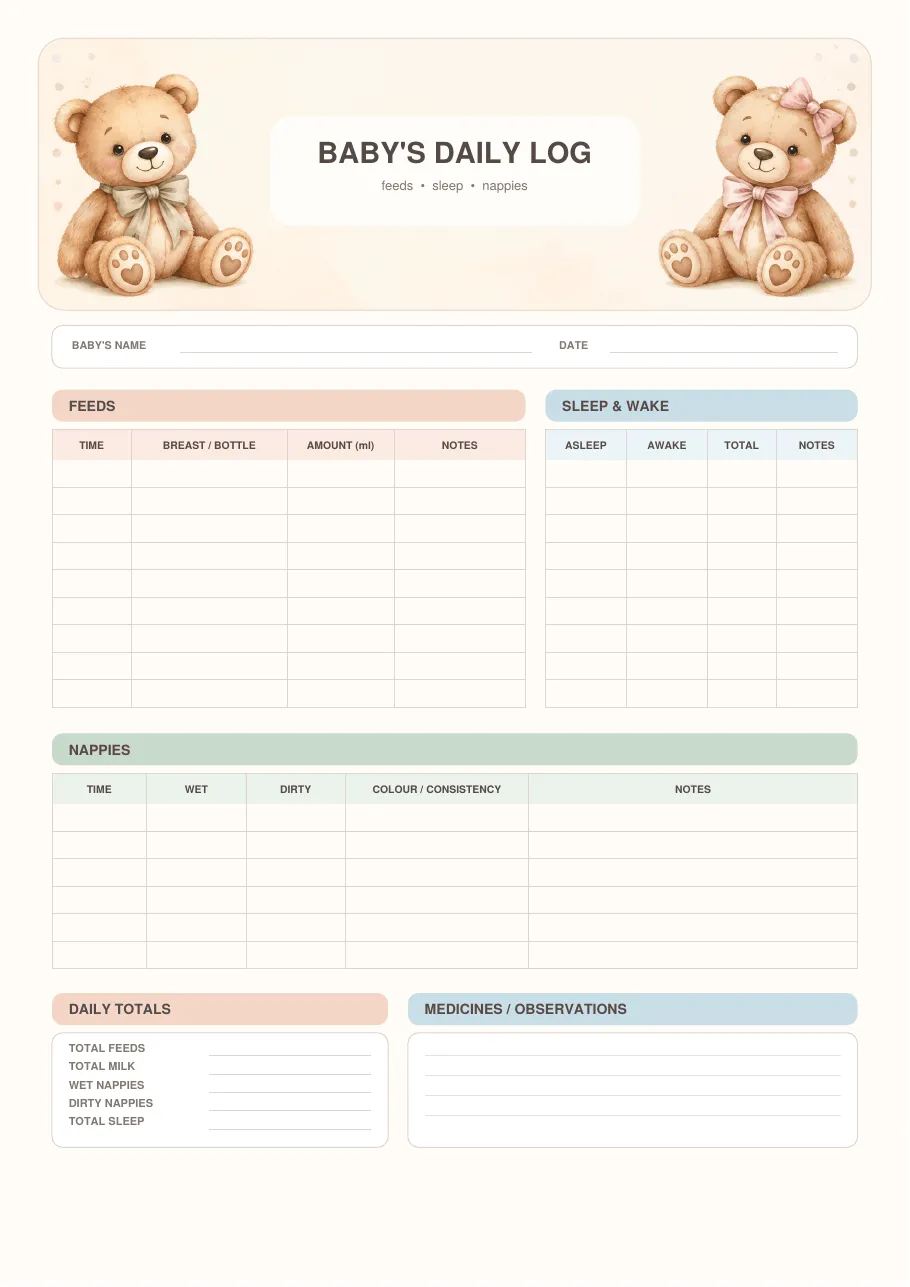
Teddy daily log
Two watercolour teddies at the top, one with a sage bow and one with a pink one. Warm and gentle without being sickly.
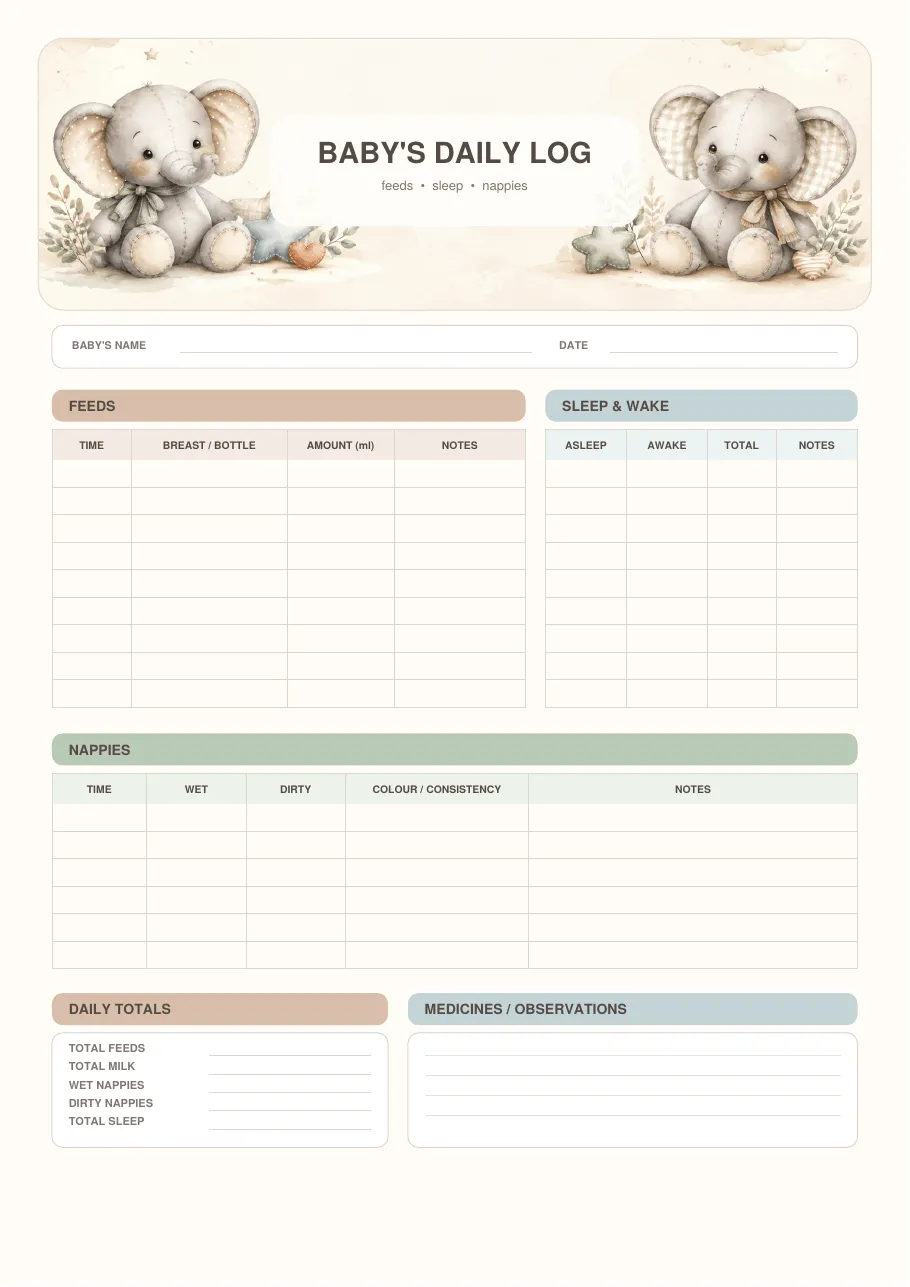
Elephant daily log
Two stitched elephants with gingham ears. The same grid underneath, softer colours on top.
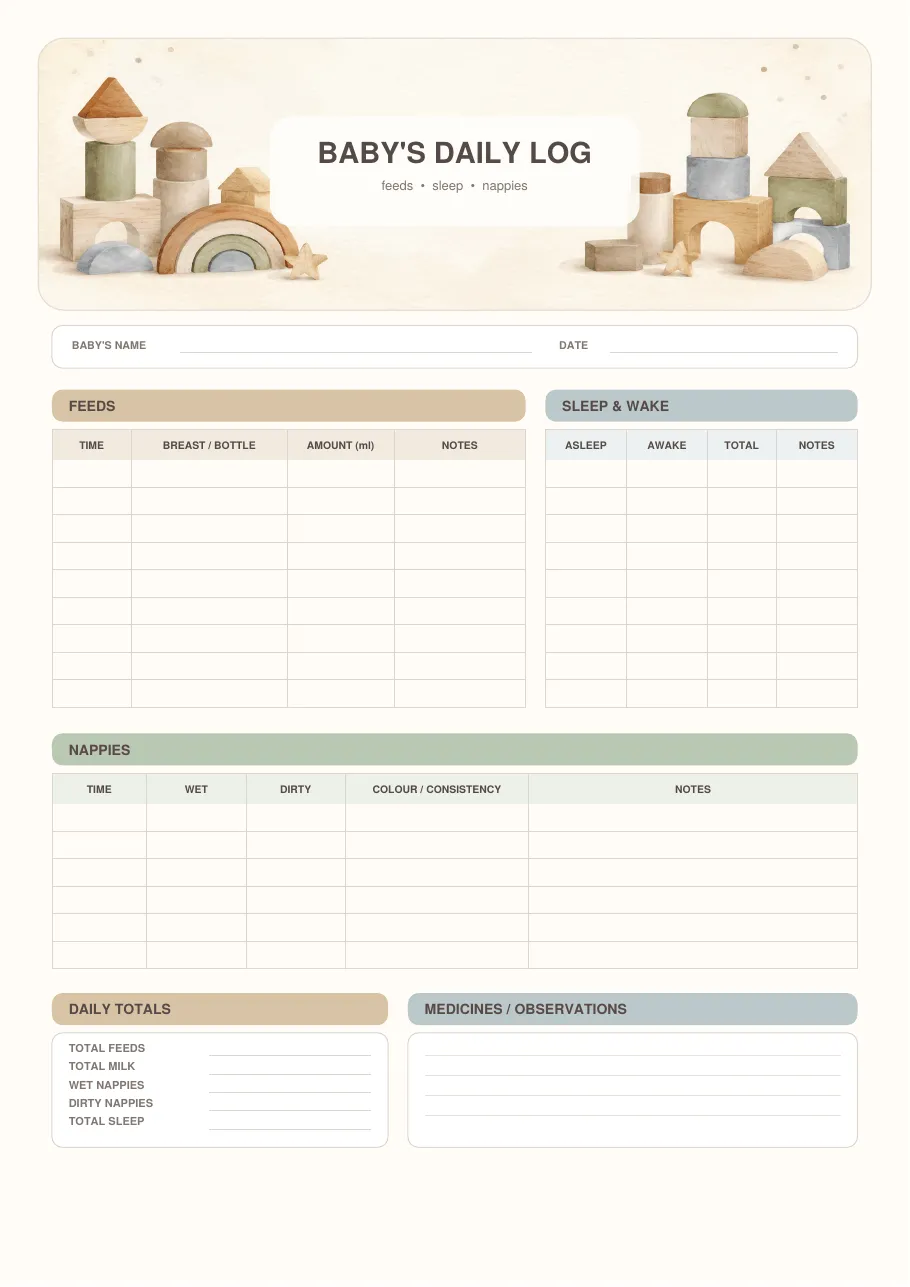
Wooden blocks daily log
Stacking blocks and a wooden rainbow, in muted greens and browns. The least pastel of the illustrated three.
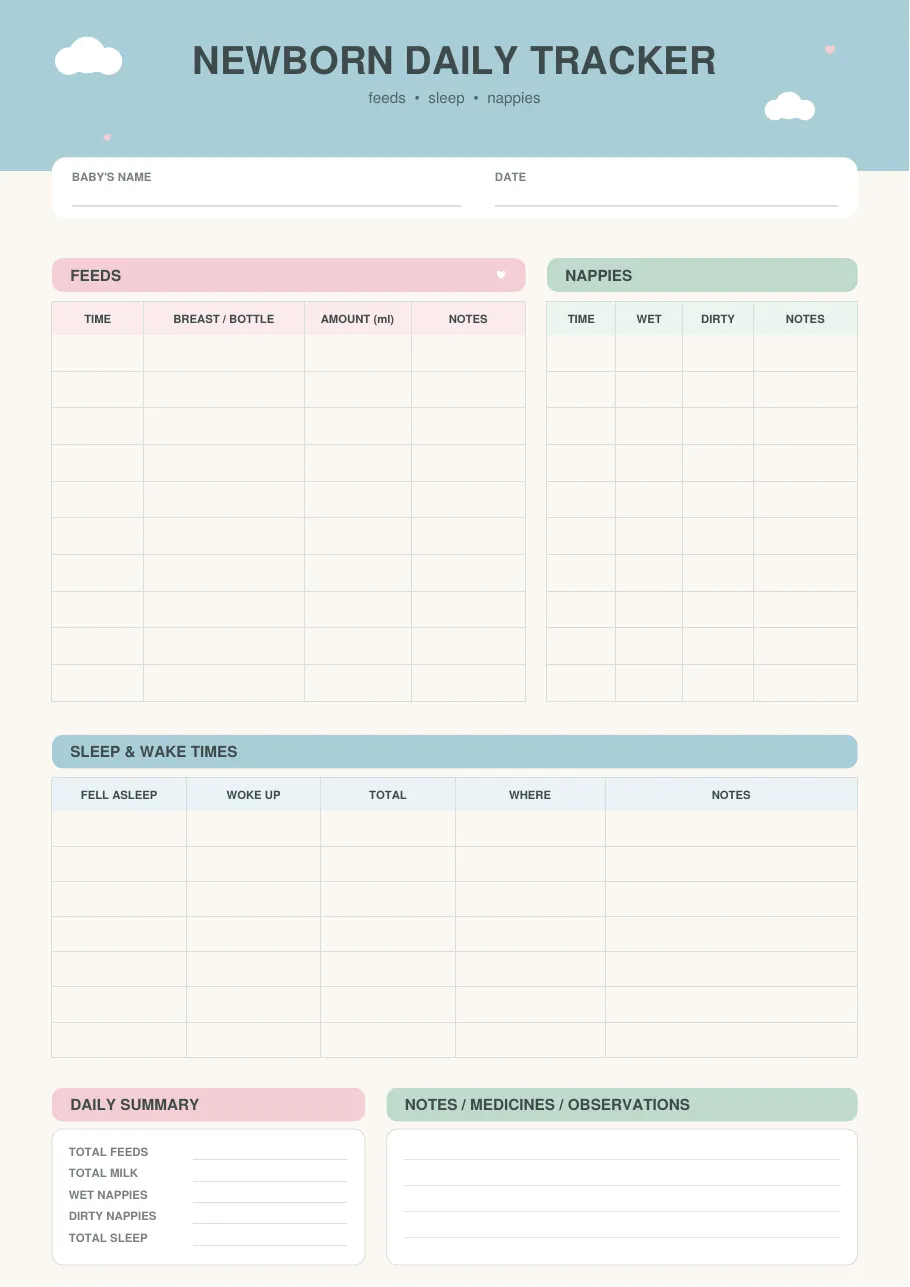
Plain daily log
No pictures, no colour blocks, no fuss. The version to print when you are getting through one a day and the cartridge is making noises.
Printing a week at a time
- One sheet per day, portrait A4. Print a week at a time and keep them on a clipboard where you feed, because a log in another room doesn't get filled in.
- The plain version is the ink-light one. Print that if you're getting through a sheet a day.
- Take the sheet to health visitor and GP appointments. It's considerably easier than trying to remember Tuesday.
Common questions
Do I need to write any of this down?
Only if it helps you. Some families never record a thing and get on beautifully. A log earns its place if a midwife or health visitor has asked for one, if you're changing how you feed, or if you would simply rather not rely on a memory that's currently running on four hours of sleep.
There's a lot of space on here. Am I meant to fill it all in?
No. It's a big grid because some days are busy, not because the grid is a target. Gaps aren't failures, and nobody is marking it.
Should I be counting nappies?
Nappies are one of the things health professionals ask about, so having a record is genuinely useful. What counts as normal varies by age and by baby, so let your midwife or health visitor read it rather than a chart on the internet.
When should I stop?
When it stops helping. Most people drift off it somewhere in the first couple of months, notice the sheet has been blank for three days, and never go back. That's the right ending.
Read next
A parent's guide to tummy time
What tummy time is for, when to start, how much to aim for and what to do when your baby hates it. Based on current NHS and WHO guidance, written for people who are very tired.
Printables that go with these
 4 sheets
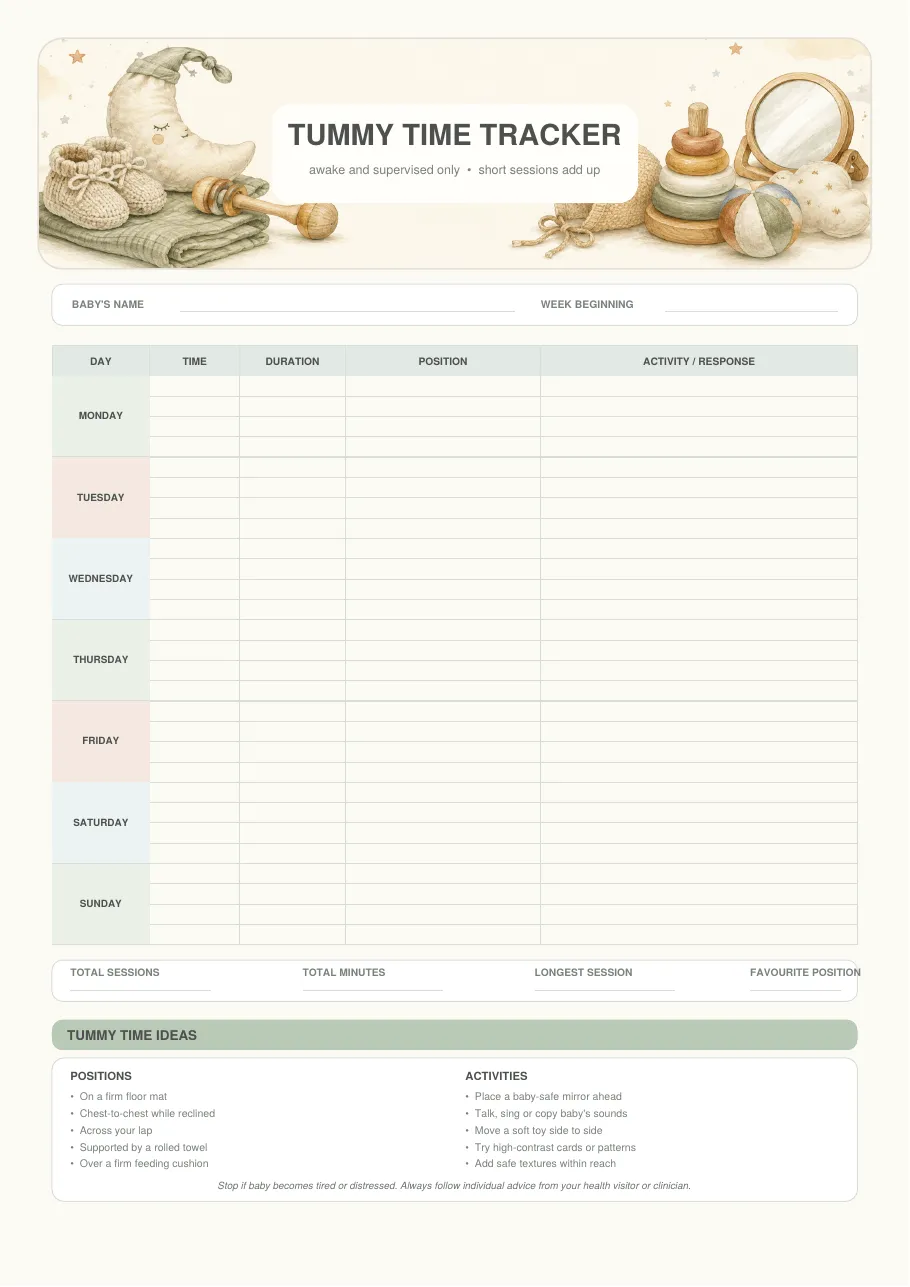
Tummy time trackers
Four free printable tummy time trackers for the first few months, with somewhere to note the position, how long you managed and whether anybody enjoyed it. Blue, pink, illustrated and a plain ink-light version.
 1 sheet
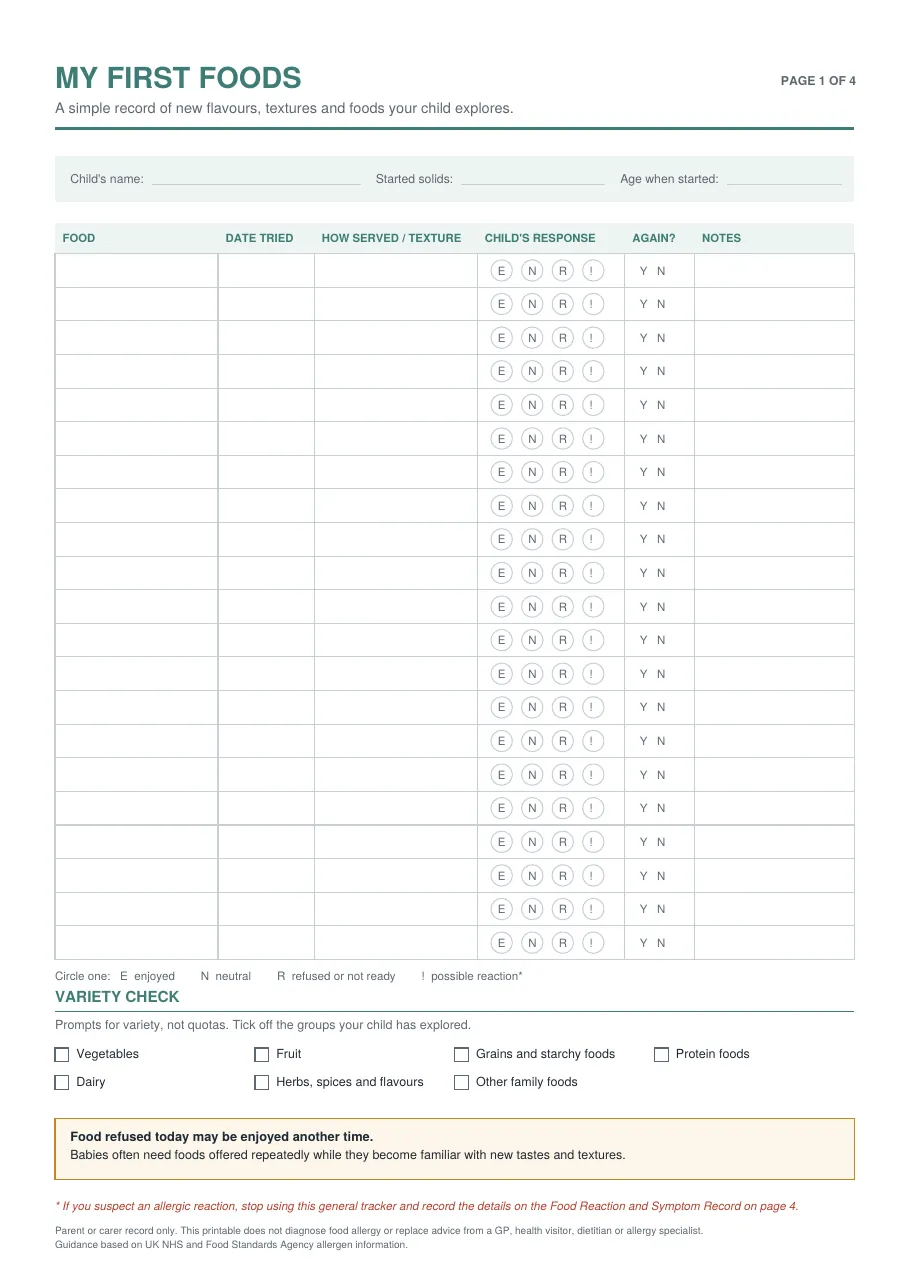
First foods and allergen tracker
A free printable four page tracker for weaning. Somewhere to record new foods, a chart for introducing the UK 14 allergens, a page for keeping them in the diet afterwards, and a detailed reaction record to take to an appointment.
 1 sheet
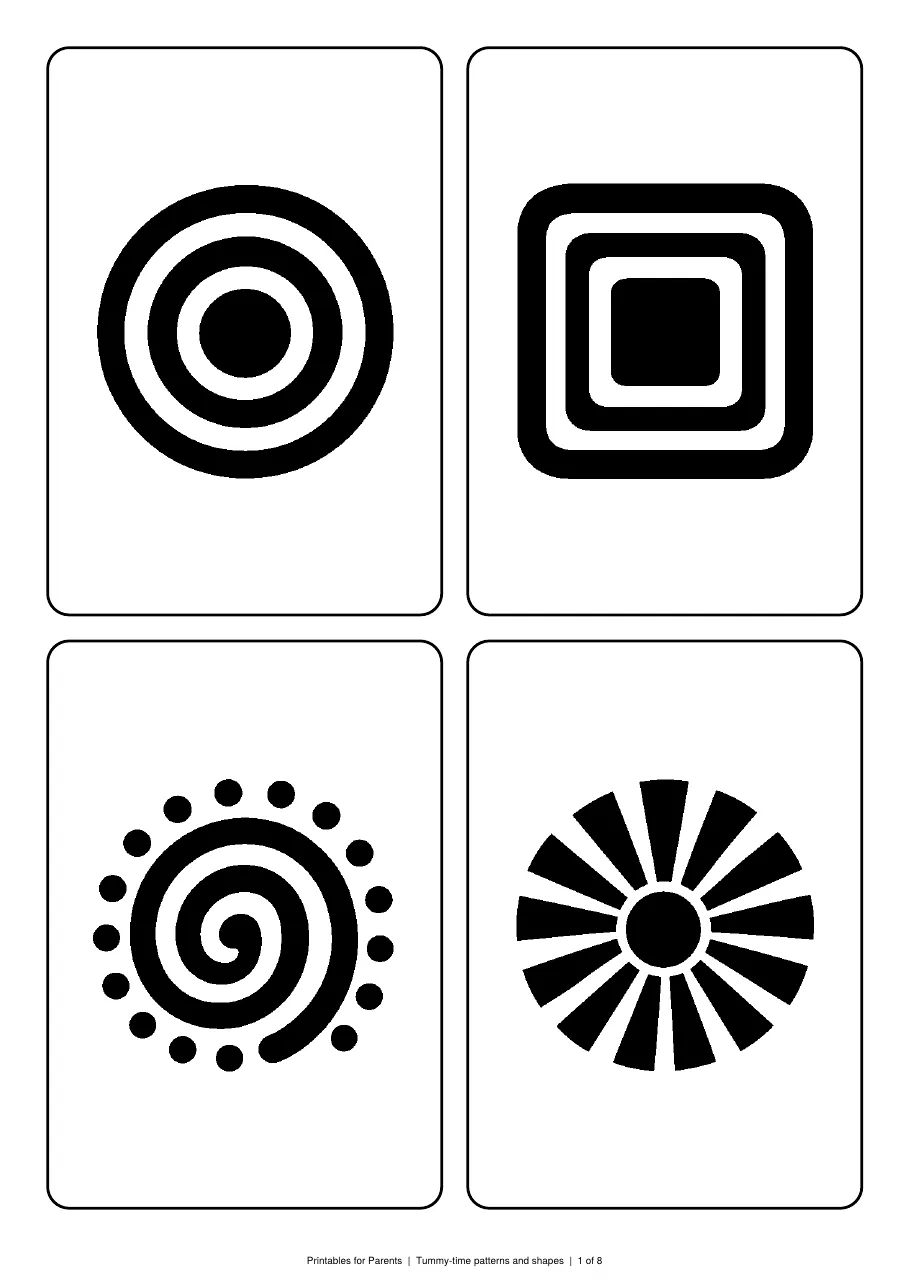
High contrast baby cards
Thirty two free black and white cards for newborns, four to an A4 page, with patterns, shapes, faces and animals to prop up during tummy time or hold at the distance a new baby can actually focus on.
 1 sheet
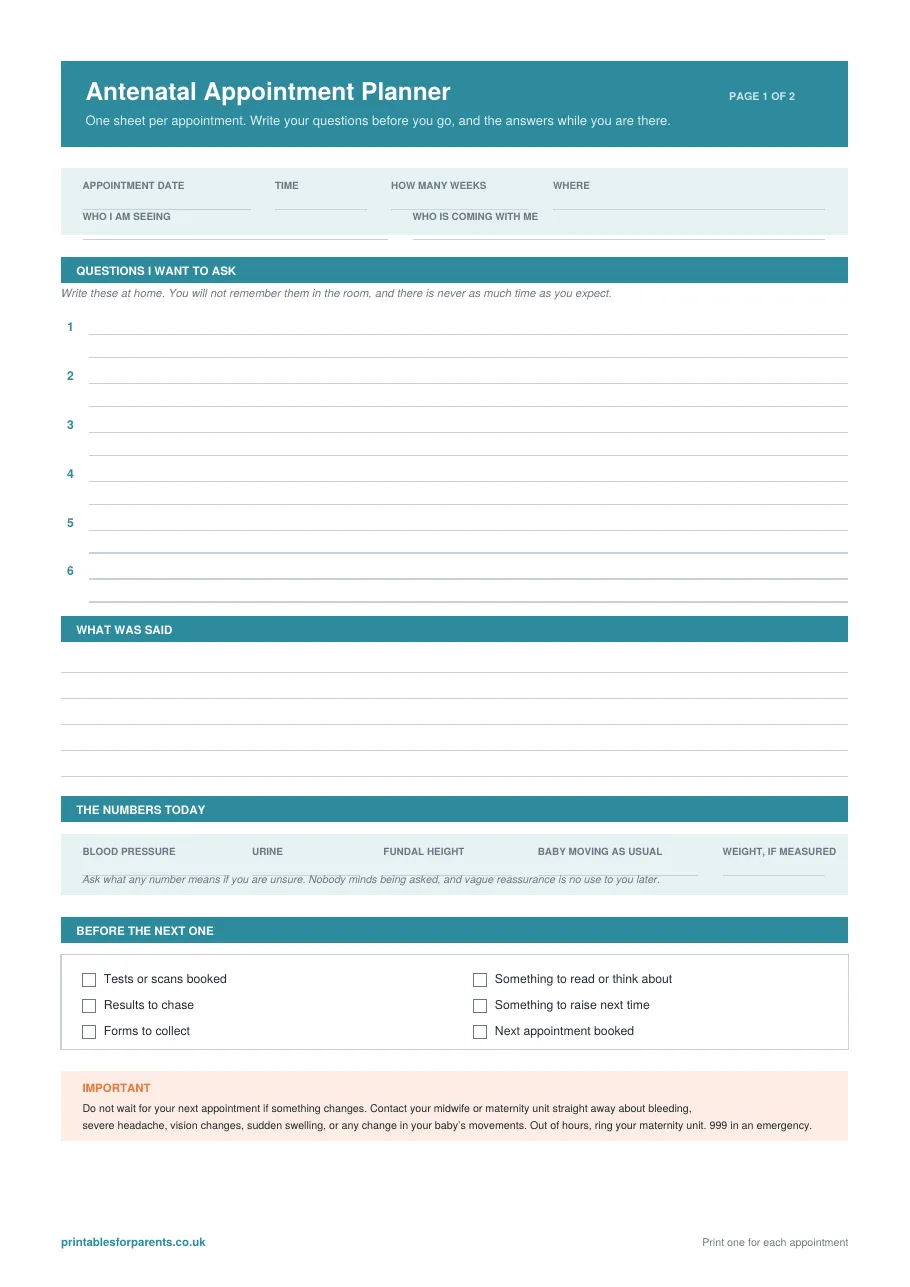
Antenatal appointment planner
A free printable planner for your antenatal appointments. One sheet per appointment for the questions you meant to ask, plus a page holding the whole schedule so you can see what's booked and what isn't.