Guide
A parent's guide to tummy time
What tummy time is for, when to start, how much to aim for and what to do when your baby hates it. Based on current NHS and WHO guidance, written for people who are very tired.
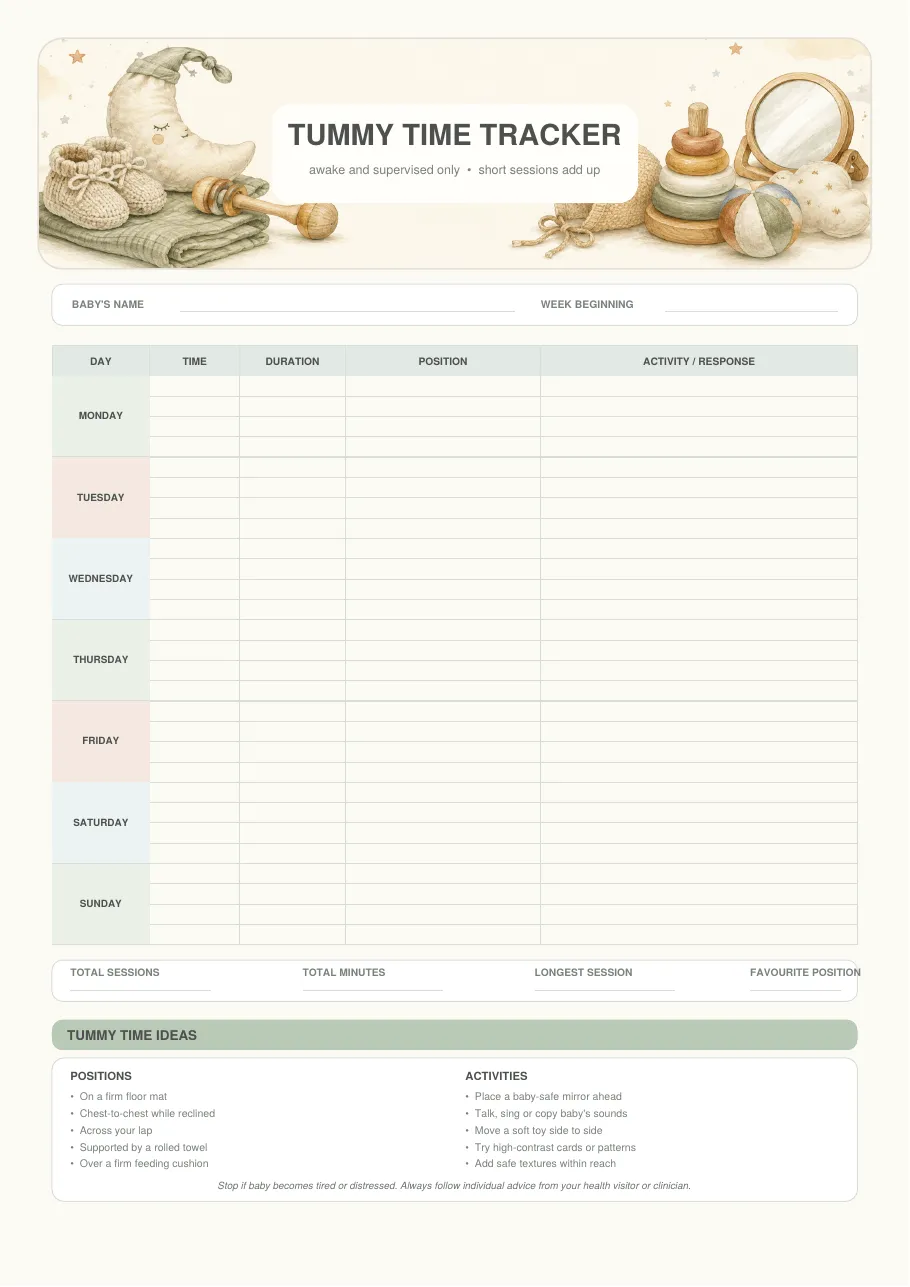
Tummy time is one of those pieces of advice that arrives with no explanation attached. Somebody says the words at a weigh-in clinic, you nod, and then you go home and put your baby face down on a mat and both of you have a perfectly awful minute. That was us, on the living room floor, for about three weeks. What finally helped was propping up a high contrast card where she could see it, and keeping a tracker so I could tell whether we were actually getting anywhere.
So here’s the explanation, the actual numbers, and what to do when it goes badly.
What it is, and why anyone bothers
Tummy time is simply time your baby spends on their front while they’re awake and you’re watching. That’s the whole definition. It doesn’t have to happen on the floor.
Working against gravity in that position builds the muscles in the neck, shoulders, back and hips. Those are the muscles behind holding their head up, rolling over, sitting, and eventually crawling and walking. It also gives them a different view of the world, which matters more than it sounds when the alternative is a ceiling.
There’s a second reason. Since the back to sleep campaign, babies spend a great deal of time lying on the back of their heads, and a baby’s skull is soft. Varying the position takes the pressure off and helps prevent the flattening that some babies develop.
The rule that matters most
Back to sleep, tummy to play.
Tummy time is awake, supervised time. Babies are put down on their backs for every sleep, every nap and every night, without exception. If your baby falls asleep during tummy time, that’s your cue to move them on to their back.
If you’re doing chest to chest tummy time, you need to be wide awake and confident you won’t drop off yourself. On the sofa at three in the afternoon on four hours sleep is exactly the situation this warning exists for.
When to start
NHS guidance is from birth.
In practice, the first version of tummy time is your baby lying on your chest while you’re propped up and thoroughly awake. It counts. Nobody is expecting a two day old on a play mat.
Starting early is genuinely easier than starting late, because babies who never experience the position tend to object more strongly when it finally arrives at eight weeks. But if you’re reading this and your baby is already three months old and has never done a minute of it, start today and stop feeling bad about it.
How much, honestly
Start with a minute or two at a time, two or three times a day, and build up as your baby gets stronger.
The figure you’ll see quoted is at least 30 minutes a day, spread through the day, for babies who aren’t yet mobile. That comes from the World Health Organization guidance that the NHS follows for under fives.
Read that number as a destination. Nobody gets there in week one, and it’s a total accumulated across the day in small pieces rather than one half hour session. Six five minute goes is the same number and infinitely more realistic.
Good moments and bad moments
Straight after a feed is the worst possible timing, for reasons that will become apparent on your jumper. Give it a while.
After a nappy change works well, because they’re already down there and undressed. So does just after waking, when they’re alert but not yet hungry or cross.
A miserable baby isn’t about to be talked round. If they were already grumbling before you started, this isn’t the moment.
When your baby hates it
Extremely common, and not a sign of anything. It’s hard work and their muscles are tiny.
Chest to chest. Lie back, put them on you, and look at each other. Easiest sell there is, and it still does the job.
Across your lap. Face down over your thighs, with a hand on them. Gentle, and a good halfway house before the floor.
Rolled towel under the armpits. Props the chest up slightly so lifting the head is less of an effort. Physiotherapy departments suggest this one constantly.
Side lying. If they won’t tolerate being on their front at all, lying on one side is a useful alternative while you work up to it.
Get down there with them. Your face at floor level beats every toy ever made. A baby safe mirror is the next best thing.
Little and often. Three cheerful minutes scattered through the day beats one grim ten minute stand off, every time.
Once they start rolling
The rules change slightly. A baby who can roll should never be doing tummy time on a sofa or a bed unless you’re within arm’s reach, because the edge arrives faster than you would think.
By this stage most babies are also perfectly capable of rolling themselves on to their front during sleep. That’s fine and you don’t need to keep flipping them back. They still go down on their back at the start of every sleep.
If your baby was premature
Everything here applies, but the timeline moves. Milestones are usually judged from your baby’s corrected age rather than their birth date, and if you have a neonatal or developmental team involved, their advice comes first. Twins and triplets often reach things a little later too.
When to ask someone who knows
Speak to your health visitor, family nurse or GP if:
- your baby’s head control isn’t improving by around six to eight weeks
- they can’t lift their head at all when on their front, or can’t prop on their forearms as the weeks go on
- they always turn their head to the same side, or seem to prefer one side strongly
- you notice their head shape flattening at the back or on one side
- anything else about how your baby moves is worrying you
None of that is an emergency and none of it is your fault. Head shape and neck tightness are both common, both treatable, and both much easier to sort out early. A health visitor has seen it hundreds of times.
Does it really matter if we skip it?
A fair question, and the honest answer is less dramatic than the internet suggests.
Babies who do very little tummy time have been found to reach some motor milestones slightly later than babies who do plenty. They still learn to walk, and still within the normal range. So this is worth doing, and it isn’t worth losing sleep over, which you don’t have to spare anyway.
Do what you can, in small friendly amounts, and let the rest go.
Where this comes from
The guidance above follows the NHS advice on tummy time and baby movement, and the UK physical activity guidelines for children under five, which align with the World Health Organization recommendations for infants. You can read both at nhs.uk.
This is general information rather than advice about your baby. Your health visitor, family nurse, GP or midwife knows your child and this website doesn’t.
Common questions
When should tummy time start?
NHS guidance is from birth. In the first days that usually means lying your baby on your chest while you're wide awake and certain you won't doze off, rather than putting them on the floor.
How much tummy time does a baby need?
UK and World Health Organization activity guidance suggests working towards at least 30 minutes a day for babies who aren't yet moving around, spread across the day rather than done in one go. That's a target to build up to over weeks and months, not something to expect in the first fortnight.
Can my baby nap on their tummy?
No. Tummy time is awake, supervised time only. Babies are placed on their backs for every sleep, day and night. The phrase used in the UK is back to sleep, tummy to play.
My baby screams every time. Am I harming their development?
No. Research on babies who had little tummy time found some motor milestones arrived slightly later, but they still walked within the normal range. It's worth persisting in small friendly doses, and there are gentler positions that count, but nobody has ruined anything.
When should I speak to a health visitor?
If your baby's head control isn't improving by around six to eight weeks, if they can't lift their head at all when on their tummy, if they always turn their head to the same side, or if you notice their head shape flattening. None of these are emergencies, and all of them are worth a conversation.