High contrast baby cards
Thirty two free black and white cards for newborns, four to an A4 page, with patterns, shapes, faces and animals to prop up during tummy time or hold at the distance a new baby can actually focus on.
Also known as: high contrast baby cards, black and white cards for newborns, newborn visual stimulation cards, tummy time cards, high contrast images for babies.
What a new baby can actually see
Not very much, and that’s the whole reason these work.
For the first few months a baby focuses best at roughly the distance between your face and theirs while you’re holding them, somewhere around 20 to 30cm, and everything past that’s soft. Colour vision arrives gradually over the same period. What a newborn can pick out easily is the difference between very dark and very light, which is why a bold black shape on white paper holds their attention when a pastel mobile does nothing at all.
I didn’t know any of this with my first and spent a fortune on a pale grey elephant. The cards cost the price of a print job and she stared at the spiral one for about four minutes, which at three weeks old felt like an achievement for both of us.
How to use them
Prop one up in front of your baby during tummy time, or hold it while they’re lying on their back or on your chest. Close, and only one at a time. A card at arm’s length is a grey rectangle to them.
Keep it short. A few minutes is plenty, and the moment your baby turns away, goes glassy or starts to grumble, that’s the end of the session. Overstimulation is real and a new baby has a very small budget for it.
Swap the card rather than adding more. The sunburst and the bullseye get an entirely different look from most babies than the faces do, and working out which ones yours prefers is half the fun of the first month.
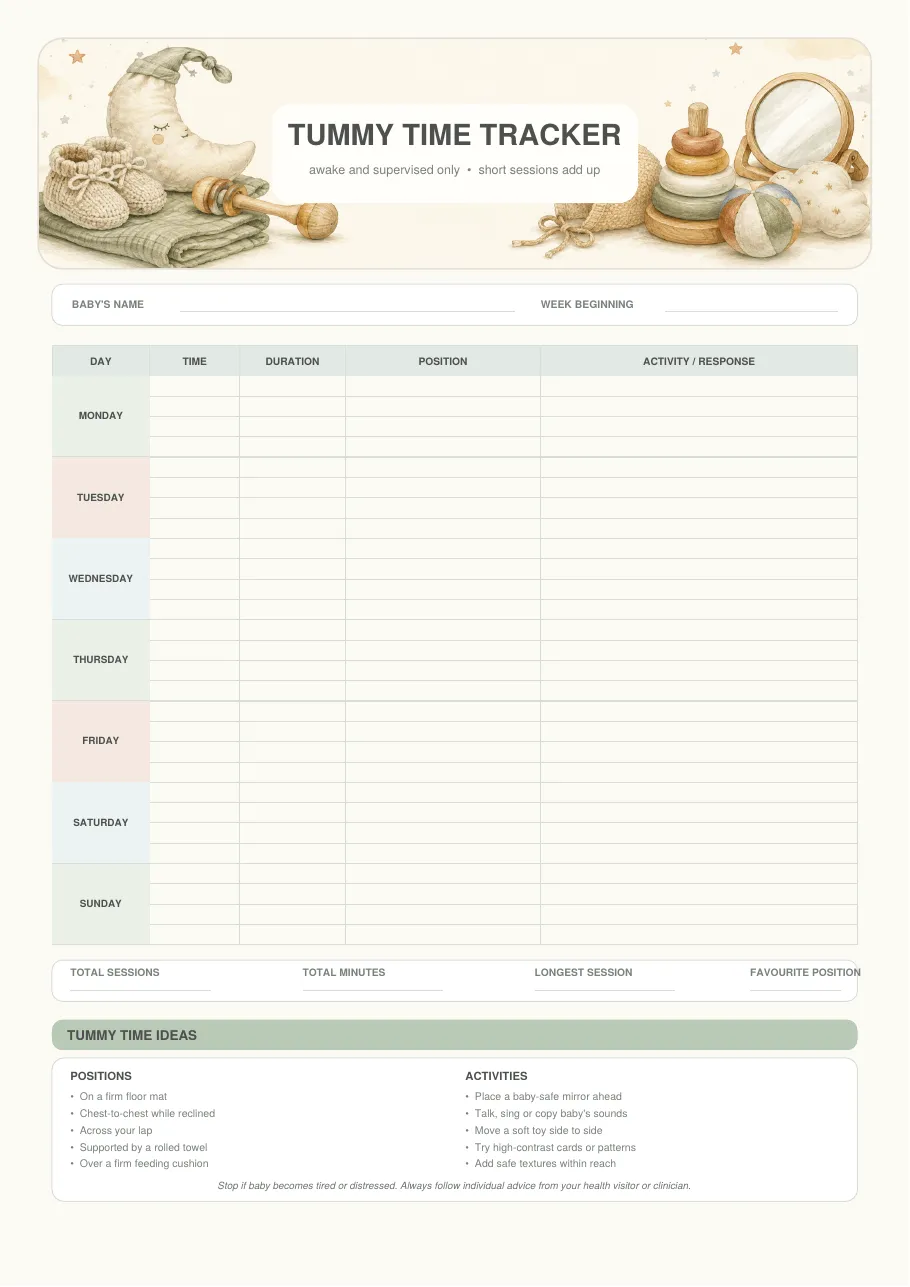
A card propped in front of them is one of the easier ways to buy an extra thirty seconds on the mat, so if you’re keeping a record, the tummy time trackers have a column for the position you used and how it went.
These don’t go in the cot
Worth saying plainly, because it’s the obvious thing to do with a laminated card and a sleeping baby. Safer sleep guidance is that a cot should be kept clear of toys, bumpers, loose bedding and anything else that could cover a baby’s face. A card taped to the inside of a cot, or left on the mattress, goes against that.
Use them out of the cot, while your baby is awake and somebody is with them. On the wall beside the changing mat, propped against the skirting board by the play mat, held in your hand: all fine. Anywhere your baby sleeps, no.
What’s on them
Eight pages, thirty two cards. The first pages are pure pattern: bullseyes, concentric squares, spirals, sunbursts, checks, zigzags and waves. Then some recognisable shapes with pattern inside them, a star, a moon, a heart, a rain cloud. Then flowers, a leaf, a tree and a mushroom. The last page is four faces, a smiley circle, a smiley square, a bear and an owl.
The faces are last on purpose. Babies are drawn to faces from the very beginning, so those tend to be the ones that still work when the patterns have stopped being interesting.
When they stop working
Somewhere in the first half of the first year, usually. Colour vision fills in, focus reaches across the room, and a baby who can reach for things would rather do that than look at a card. Interest tailing off is what success looks like here.
If yours never took to them at all, that’s also common, and a face at 25cm beats every card in this pack.
Where this comes from
The tummy time advice follows NHS guidance, which is that tummy time can start from birth, on your chest while you’re wide awake, building up little and often, and only ever while your baby is awake and somebody is watching. The cot advice follows The Lullaby Trust, whose position is that the safest cot is a clear cot. The description of what a newborn can focus on follows the American Optometric Association and the American Academy of Ophthalmology, who both put the newborn focal range at around 8 to 10 inches and note that very young babies look longest at high contrast targets.
Sources were checked in September 2026. This is a printable and a bit of encouragement, not medical advice. If you have any concern about your baby’s sight, their head control or anything else, your health visitor and your GP know your baby and are the people to ask.
1 free high contrast baby cards to print
Every sheet is a PDF sized for A4. Tap a design to download it. No sign-up, no watermark.
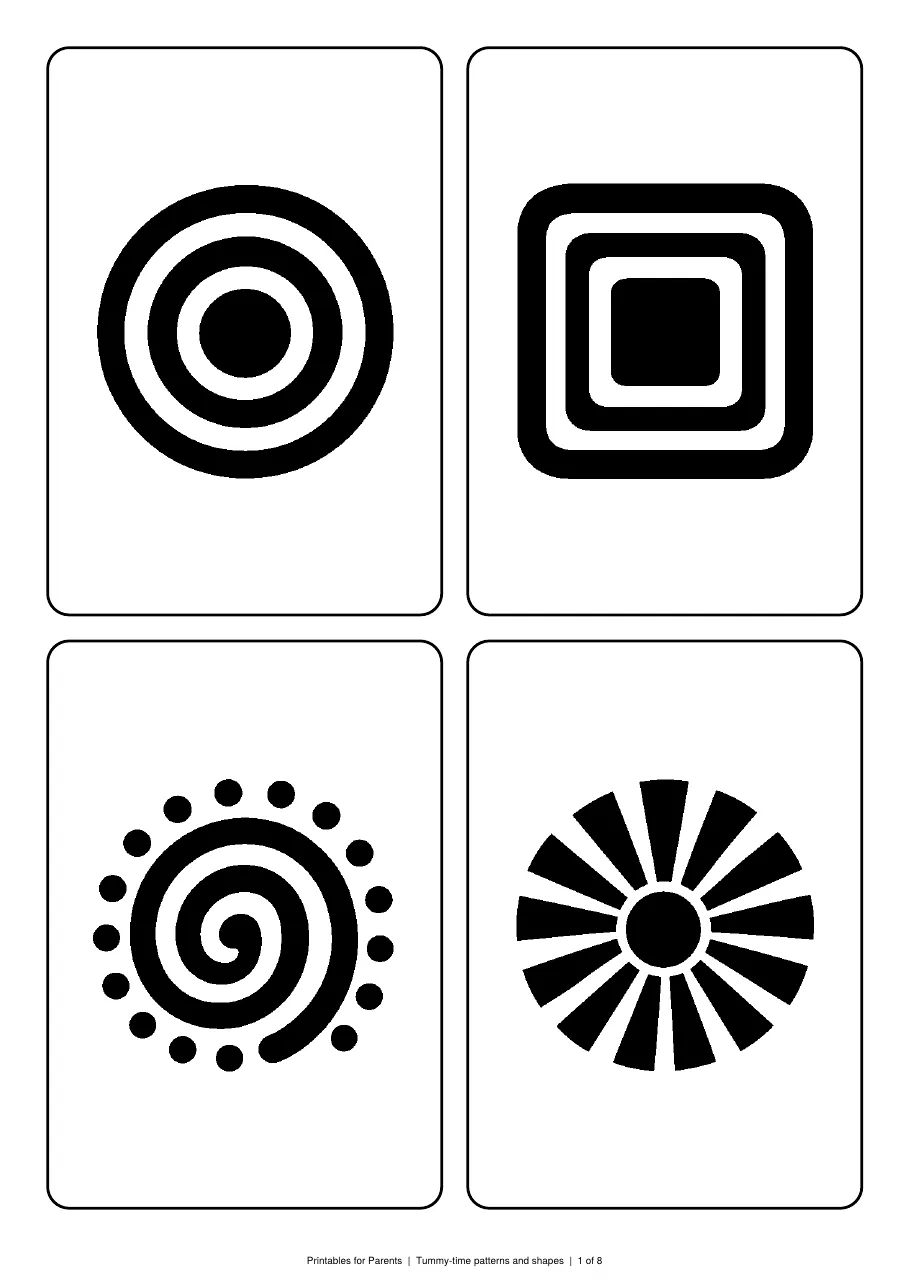
Tummy time patterns and shapes
Thirty two black and white cards over eight pages. Bullseyes, spirals, checks, zigzags, stars, a moon, leaves, a mushroom, and four simple faces at the end.
Printing and cutting the cards
- Eight A4 portrait pages, four cards to a page, each one about 91 by 132mm. That's a little smaller than A6, so two will sit side by side in most photo frames if you want one propped up permanently.
- Print at 100% or actual size rather than fit to page. Fit to page shrinks the patterns, and the size is doing half the work here.
- These are solid black on white, which is heavy going for an inkjet. A laser printer, a print shop, or the library will be considerably cheaper if you want all eight pages.
- Card or the heaviest paper your printer takes. Ordinary copier paper curls and won't stand up against anything.
- The rounded rectangles are the cut lines. A laminator is worth it here, because these end up on the floor and in a mouth eventually.
Common questions
When can I start using them?
From the beginning, whenever your baby is awake and content. Nothing about them needs waiting for, and there's no schedule to keep to.
How close should I hold them?
Closer than feels natural. Around 20 to 30cm from your baby's face, which is roughly the distance between your face and theirs when you're holding them. Further away and there isn't much point.
How long should a session be?
A few minutes, and stop when your baby stops looking. Turning away, going glassy or getting grizzly all mean the same thing. There's no benefit to pushing on.
Can I put them in the cot?
No. Safer sleep guidance is that a baby's cot should be clear of toys and loose items, and that includes these. Use them out of the cot, while your baby is awake and you're there.
My baby ignores them completely. Is something wrong?
Almost certainly not. Some babies are far more interested in faces than in patterns, and a face is better than any card anyway. If you have any concern at all about your baby's sight, that's a conversation for your health visitor or GP rather than a printable.
When do they stop being useful?
Interest usually tails off somewhere in the middle of the first year as colour vision comes in and they would rather grab things. Nothing is lost if that happens sooner.
Read next
What a newborn can see, and what to do with it
What babies can see in the first months, how far away they focus, when eye wandering should settle, and the warning signs to raise with a health professional.
A parent's guide to tummy time
What tummy time is for, when to start, how much to aim for and what to do when your baby hates it. Based on current NHS and WHO guidance, written for people who are very tired.
Printables that go with these
 4 sheets
Tummy time trackers
Four free printable tummy time trackers for the first few months, with somewhere to note the position, how long you managed and whether anybody enjoyed it. Blue, pink, illustrated and a plain ink-light version.
 4 sheets
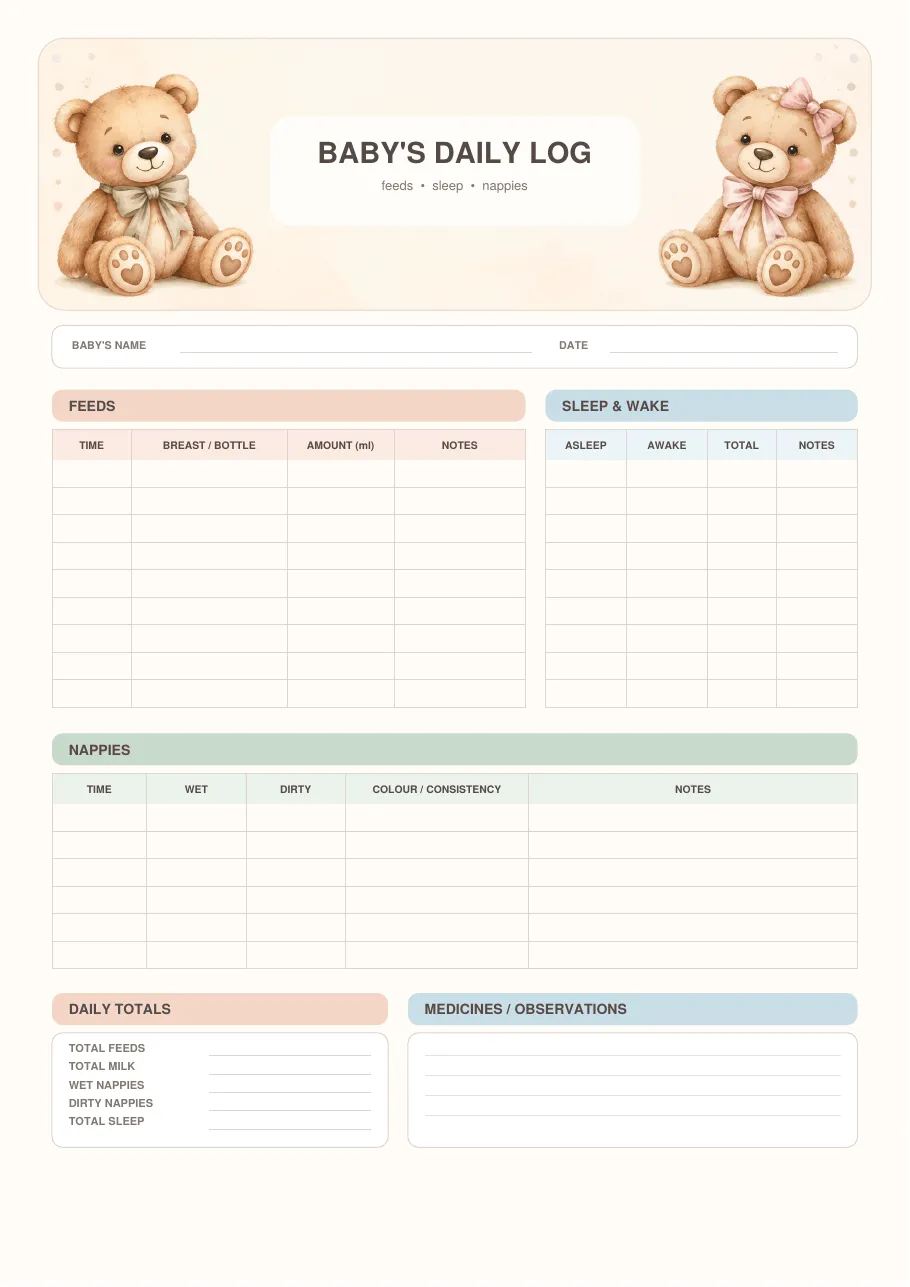
Newborn daily logs
Four free printable daily logs for feeds, sleep and nappies, all on one A4 sheet. Teddies, elephants, wooden blocks or a plain version for when the ink is running low.
 1 sheet
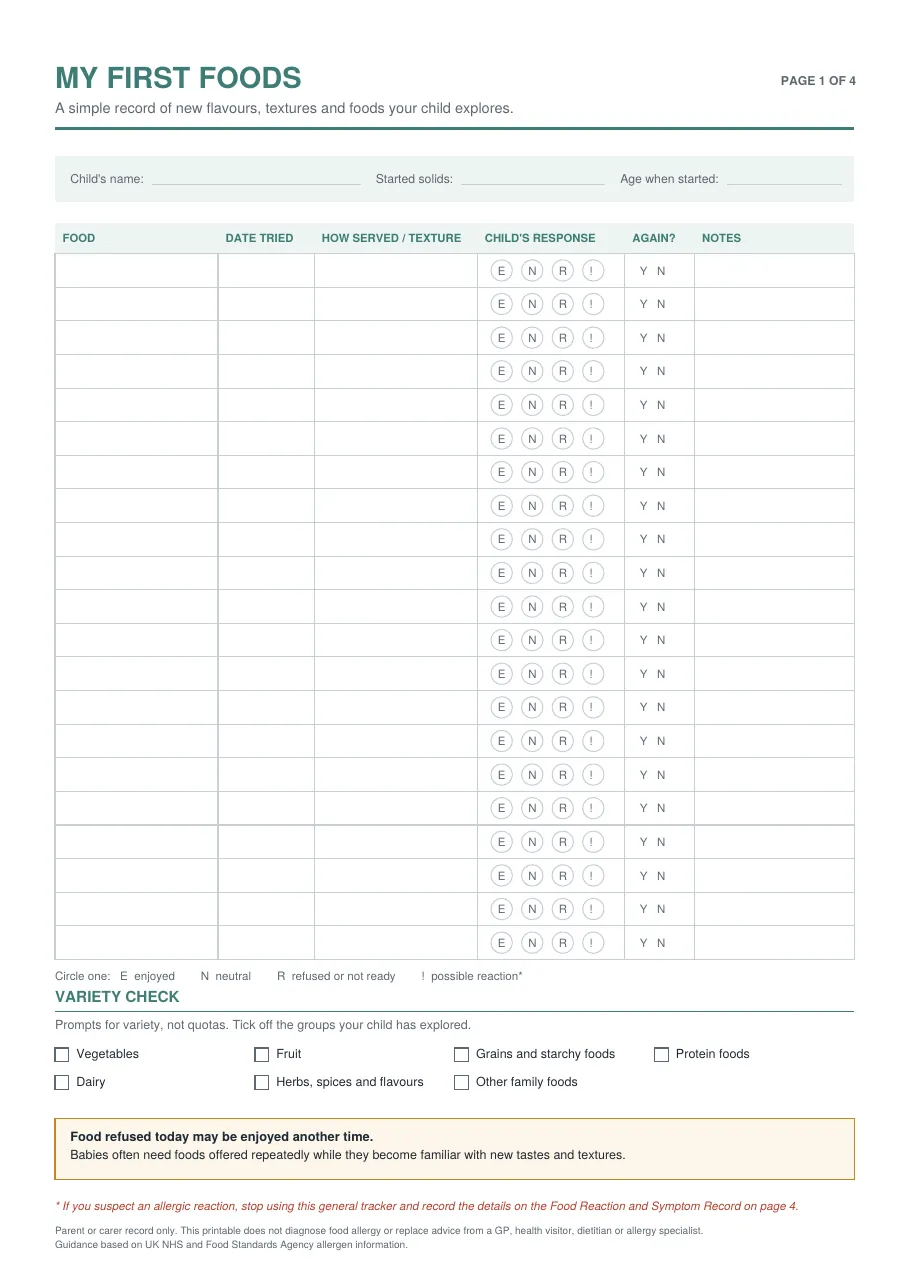
First foods and allergen tracker
A free printable four page tracker for weaning. Somewhere to record new foods, a chart for introducing the UK 14 allergens, a page for keeping them in the diet afterwards, and a detailed reaction record to take to an appointment.
 19 sheets
Christmas colouring pages and crafts
Nineteen free printable Christmas sheets. Eleven colouring pages from simple to detailed, four cards to colour and fold, a Father Christmas mask, gingerbread chains and paper chain strips.