Chore charts and pocket money sheets
Seven free printable jobs charts and a pocket money tracker. Three age bands in two versions, one with pocket money attached and one without, so you can pick the approach that suits your house.
- 3 to 12 years
- 5 and under
- Organisation
- 5 to 10
Also known as: chore chart for kids, jobs chart, pocket money chart, chore chart by age, kids chore list printable, pocket money tracker.
Two sets, because families don’t agree about this
There’s a long running argument about whether children should be paid for jobs around the house, and it doesn’t have a winner. So there are two versions of each chart rather than one.
The teal sheets say helping out. Jobs are what everyone in the house does, nobody gets paid, and the chart is there to stop you asking four times.
The coral sheets say earning. Same jobs, but with a column for what each one is worth and a total at the bottom of the week.
You only need one of each pair. The group is printed on the sheet in words as well as colour, so a greyscale print still tells you which is which.
Which one suits your house
If your worry is that nothing gets done without nagging, the teal version is usually the better starting point. It keeps the focus on the job being done rather than on what it’s worth, and it avoids the conversation where a child asks what you’re paying before they’ll pick anything up.
If your worry is that your child has no idea what money is or where it comes from, the coral version does something the other one can’t. Seeing a week of jobs add up to a figure, and then watching that figure turn into a thing they wanted, is a lesson that’s hard to deliver any other way.
Plenty of families run both at once, which is why the job lists are identical. Everyday jobs on the teal chart, and the extra jobs block on the coral one for the bigger occasional things like washing the car.
Start with fewer jobs than you think
The commonest way to wreck one of these is to fill it in completely on day one.
A chart with four jobs that actually gets finished beats a chart with ten that never does. This matters most under about six, because a half filled chart reads as failure to a small child no matter how cheerfully you present it.
Every sheet prints ten jobs, which is deliberately more than any one child should be doing at once. Treat it as a menu rather than a list. Pick the three or four that matter in your house this month and ignore the rest, which is why the 3 to 5 sheet says so across the top.
If you want the longer version of why charts fail, it’s in reward charts that actually work, and most of it applies here.
The thing worth knowing about paying
If you do go down the coral route, the one trap to avoid is paying for everything.
Once every job has a price, the jobs without a price stop happening, and you’ve accidentally taught your child that unpaid help is for other people. Most families who make it work keep a short list of things that are simply expected, and attach money to the bigger or less pleasant jobs on top of that.
The charts are built for exactly that: a printed list of regular jobs, and a separate extra jobs block underneath.
The four jobs that carry a condition
Three kinds of job need an adult involved: heat at the cooker, sharp knives, and anything with a strong cleaner in it. They’re worth doing, and a ten year old who never touches any of them arrives at sixteen unable to feed themselves. So rather than leave them off, the 10 and up chart carries them with the condition printed underneath the job, where your child will actually read it.
Four rows have one. Loading the dishwasher says sharp things only once you are ready. Using the washing machine says after you have been shown how. Cleaning the bathroom sink says only with the spray you were given. Making a simple meal says with an adult, as agreed.
The 6 to 9 chart has two of the same kind, on measuring pet food and helping get food ready.
Those conditions are the part that matters, so if you write your own jobs in the blank rows, write the condition in too.
The pocket money sheet works either way
The tracker doesn’t care where the money came from. A flat weekly amount, a total earned off the coral chart, birthday money from a grandparent, it all goes in the same column.
What it’s really for is the bit underneath. A child who’s saving for something specific, with the cost written at the top and ten blocks to colour in as they get closer, will put money away in a way that the same child with a vague sense of saving never will.
Print a fresh copy each month rather than laminating this one, because the point is to be able to look back at it.
7 free chore charts and pocket money sheets to print
Every sheet is a PDF sized for A4. Tap a design to download it. No sign-up, no watermark.
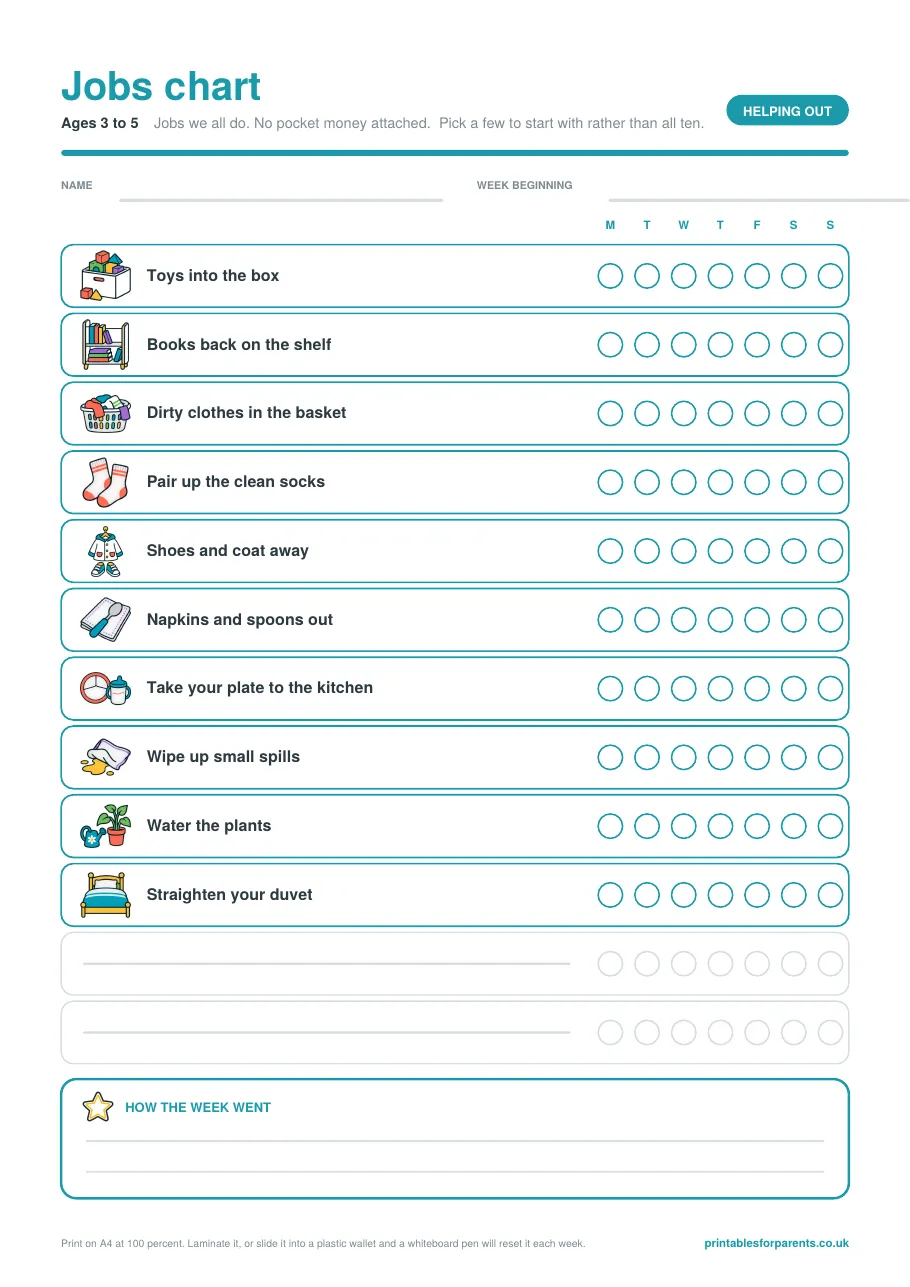
Helping out, ages 3 to 5
Ten jobs a young child can finish alone, with big rows, big tick circles and a picture against each one. No money anywhere on the sheet.
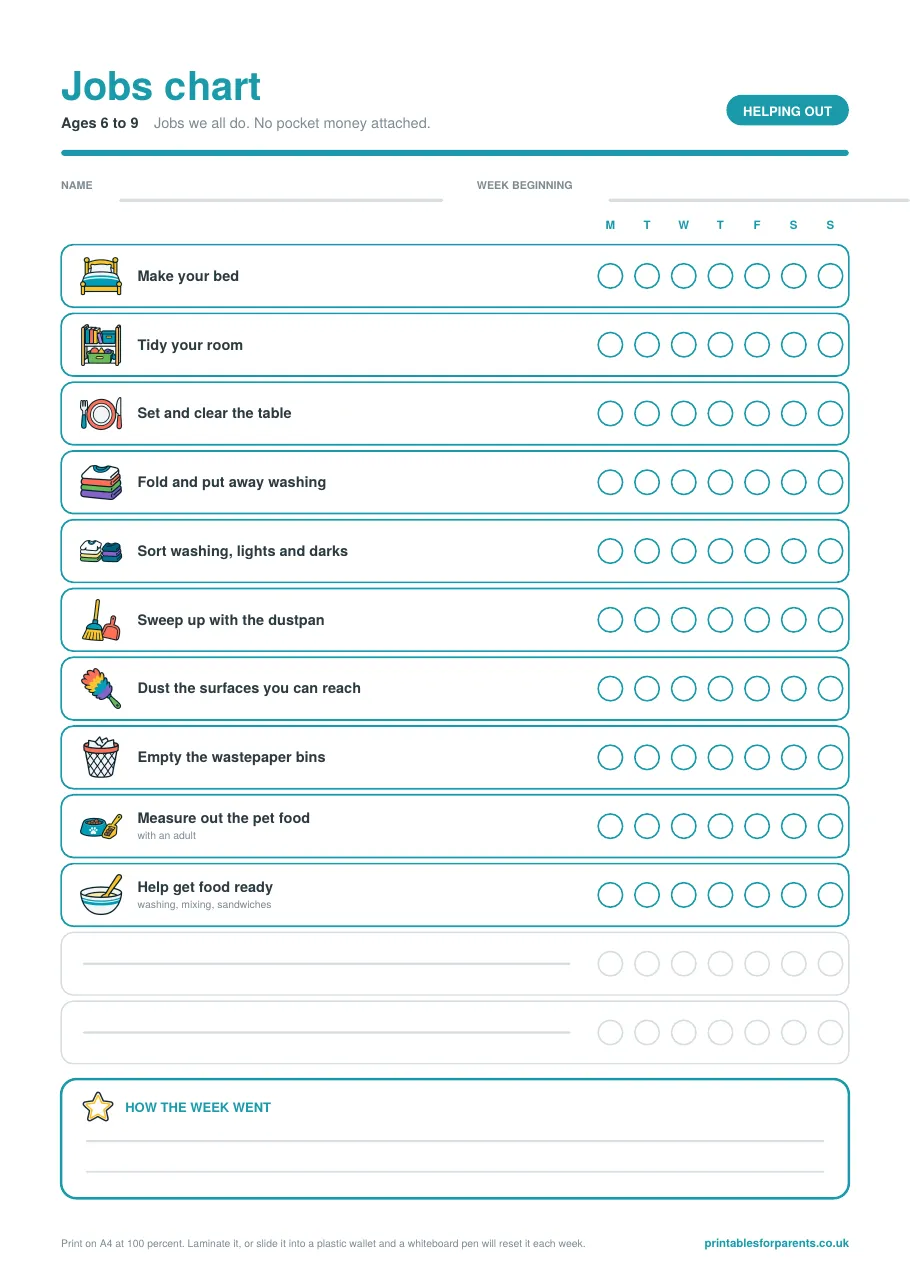
Helping out, ages 6 to 9
Ten jobs with a picture against each, two blank rows, and somewhere to write how the week went.
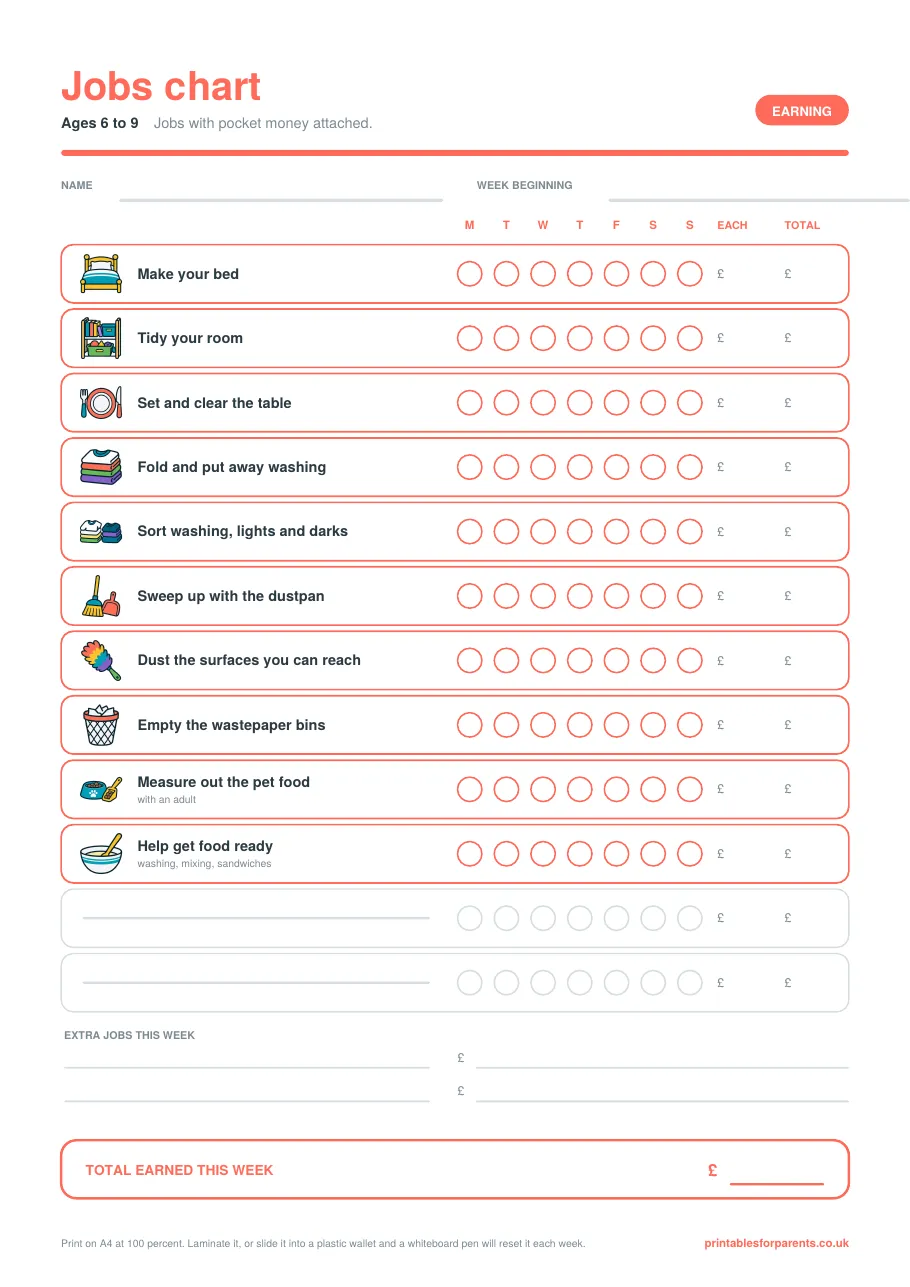
Earning, ages 6 to 9
Ten jobs with money columns, plus room to add one off jobs that came up during the week.
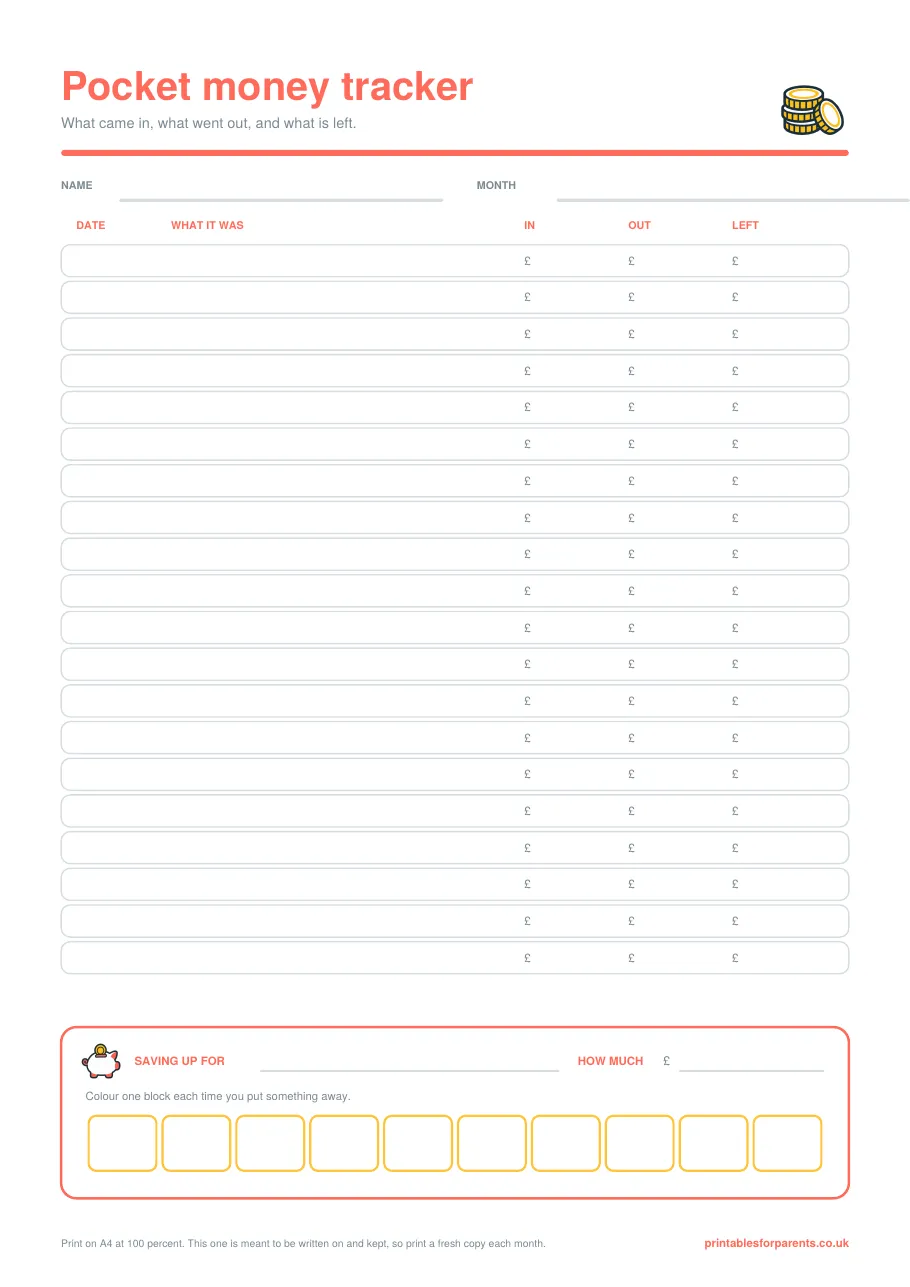
Pocket money tracker
Money in, money out, what's left, and a saving up goal with ten blocks to colour as it fills.
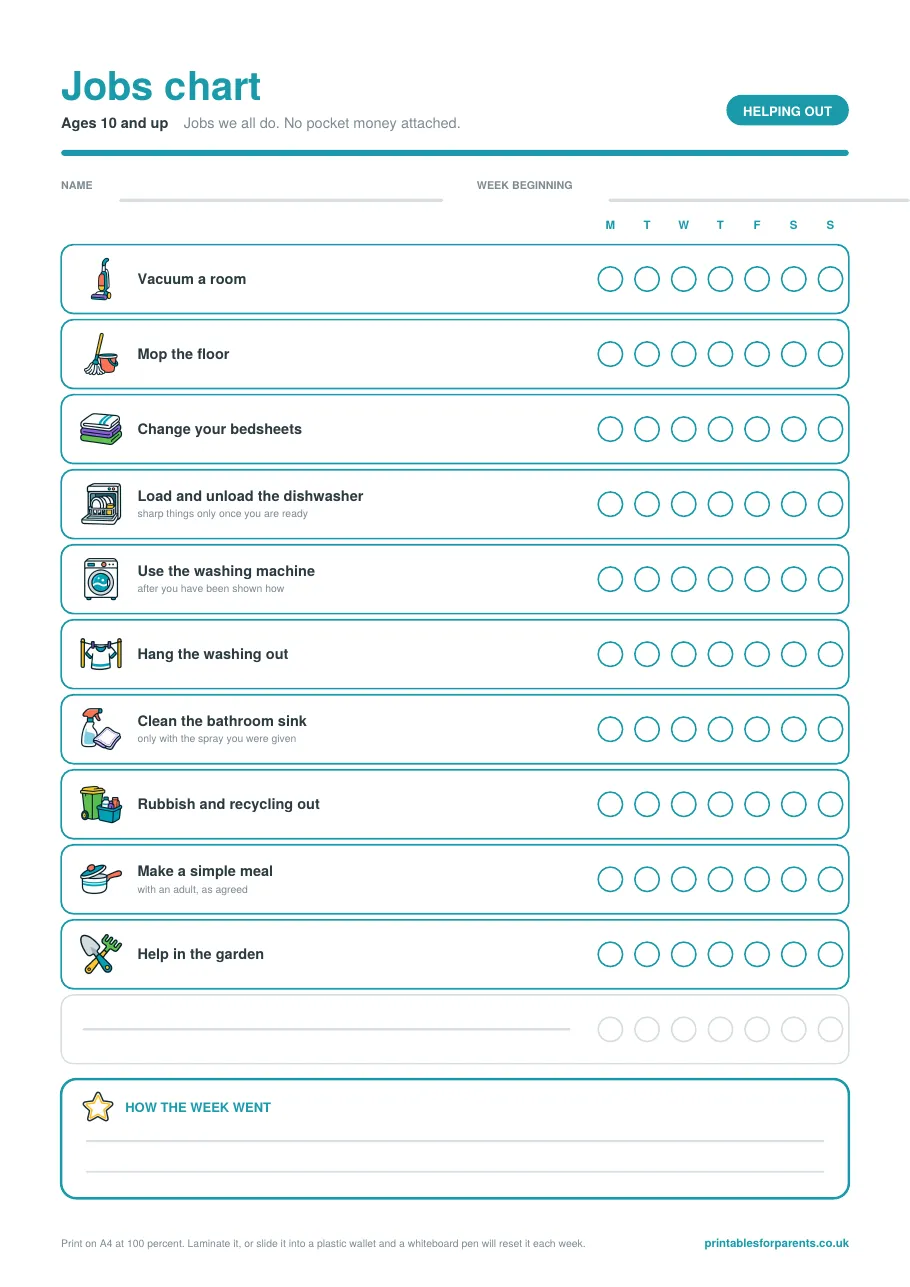
Helping out, ages 10 and up
Ten jobs including mopping, changing bedsheets and the recycling, with the conditions printed under the ones that need an adult.
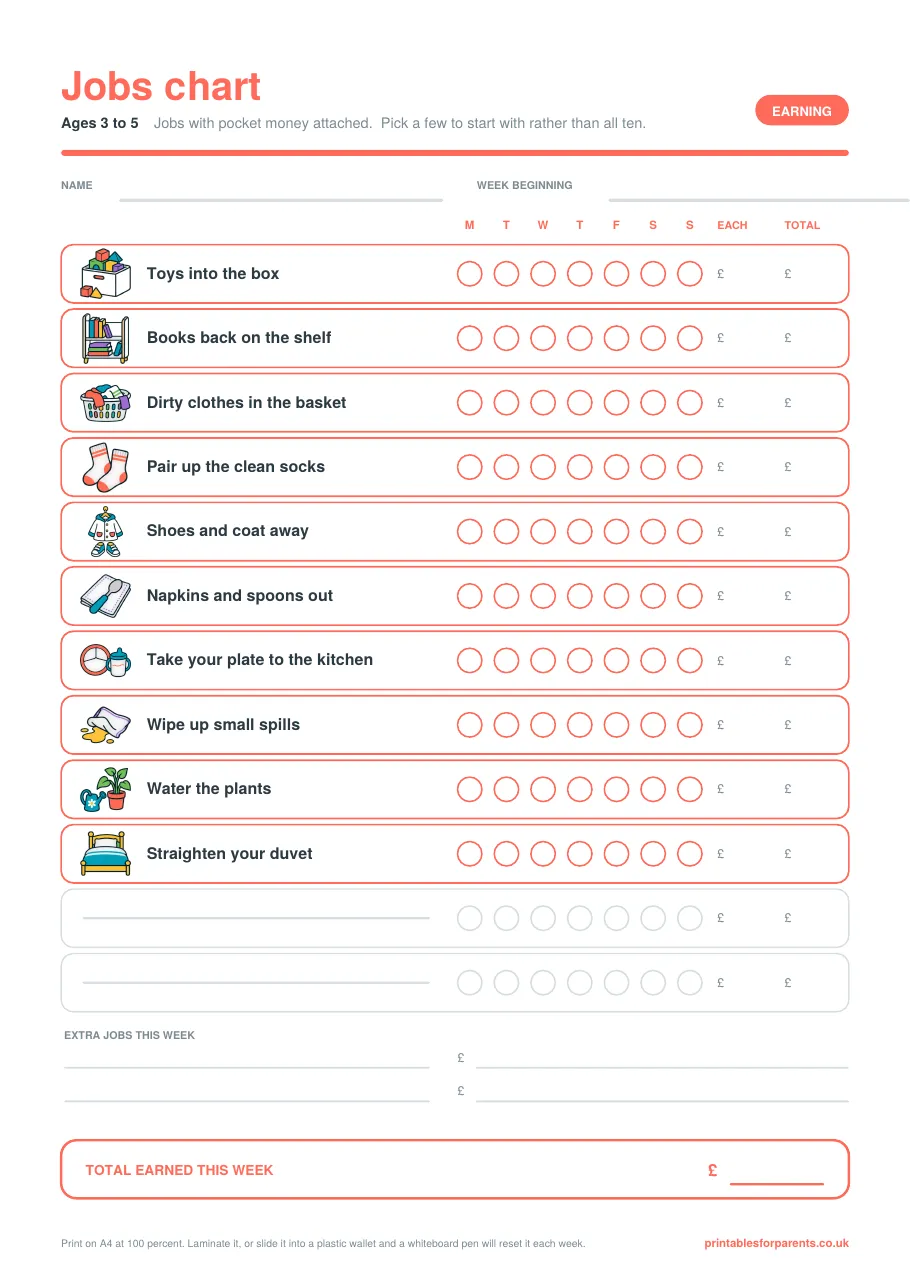
Earning, ages 3 to 5
The same ten jobs, with a column for what each one is worth and a total for the week.
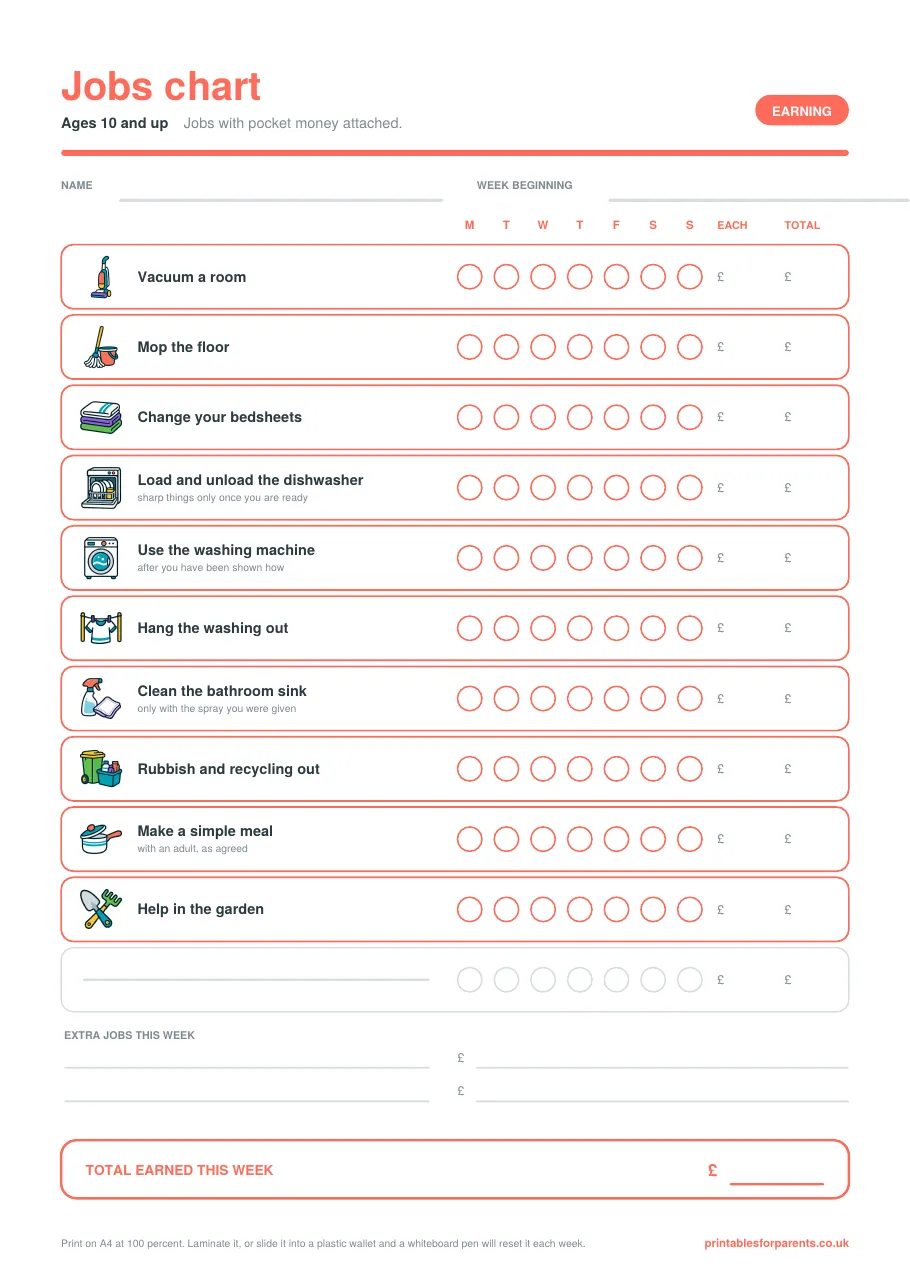
Earning, ages 10 and up
Ten jobs with money columns, an extra jobs block for one off things, and a total earned for the week.
Getting these to last more than a week
- Print on A4 at 100 percent. The teal sheets and the coral sheets are the same chart, so you only need one of each pair.
- The jobs charts laminate well, or slide one into a plastic wallet and use a whiteboard pen. One print, a whole term.
- The pocket money tracker is the exception. That one is meant to be written on in pen and kept, so print a fresh copy each month.
- Everything prints perfectly well in greyscale. The group is written on the sheet as well as coloured, so you can still tell them apart.
Common questions
Should I pay my child for doing jobs?
Families land in different places on this and both work, which is why there are two versions. The common ground is that paying for absolutely everything tends to backfire, because a child who's paid for every job will eventually ask what you're paying for the ones you haven't mentioned.
What's the difference between the teal sheets and the coral ones?
Only the money. The teal "helping out" charts treat jobs as something everyone in the house does, with no payment attached. The coral "earning" charts have a column for what each job is worth and a total for the week. The job lists are otherwise the same.
My child is 7 but can't manage the 6 to 9 list. Is that a problem?
No. The bands are a starting point, not a standard. Print the younger sheet, or use the blank rows on whichever one you like and write your own. Nobody will know.
How many jobs should be on the chart at once?
Fewer than you think, especially under about six. A chart with four jobs that gets finished beats a chart with ten that never does, and a half filled chart reads as failure to a small child whatever you say about it.
How much pocket money is normal?
There's no standard, and the amount matters far less than it being predictable. Pick something you can keep up every week without thinking about it, and say out loud what it's for, because "some of it has to last until Saturday" is the actual lesson.
What about jobs involving the cooker or cleaning products?
They're on the 10 and up chart, but with the condition printed under the job rather than left to be assumed. Cooking says with an adult as agreed, and cleaning the bathroom says only with the spray you were given. The right age for each is a judgement you're better placed to make than a printable is, so move them to the blank rows on a younger sheet if that suits your child better.
Read next
What chores at what age
What children can realistically manage around the house at each age, how many jobs to put on a chart, whether to pay for them, and which jobs want an adult alongside.
Reward charts that actually work
Most reward charts fail for the same handful of reasons. What to put on a chart, what to reward, how long to run it, and when to take it down.
Printables that go with these
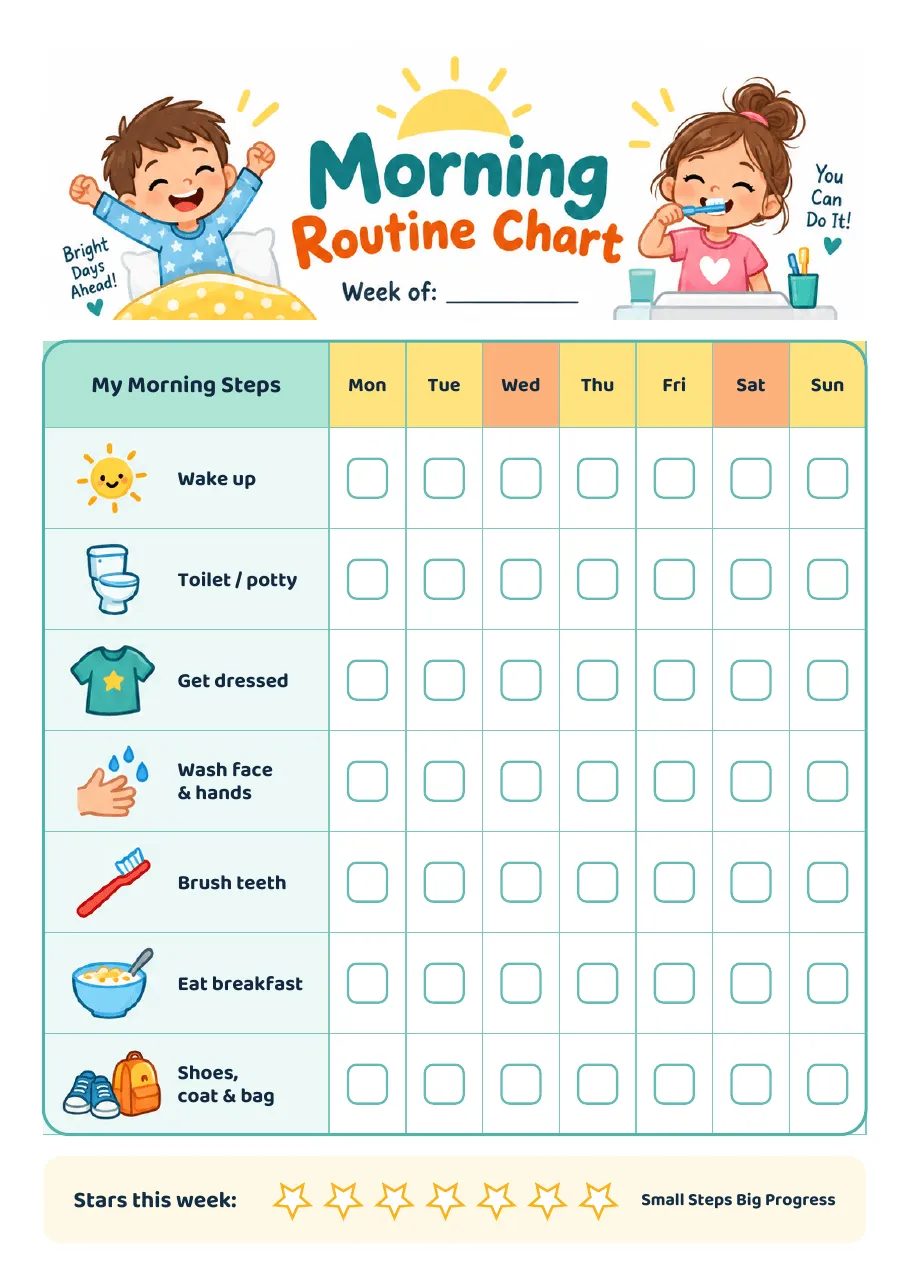 6 sheets
Routine charts
Six free morning and bedtime routine charts to print on A4, in a colourful design and in pink and blue, with picture steps a child can follow before they can read and a full week of boxes to tick.
 6 sheets
Activity and club trackers
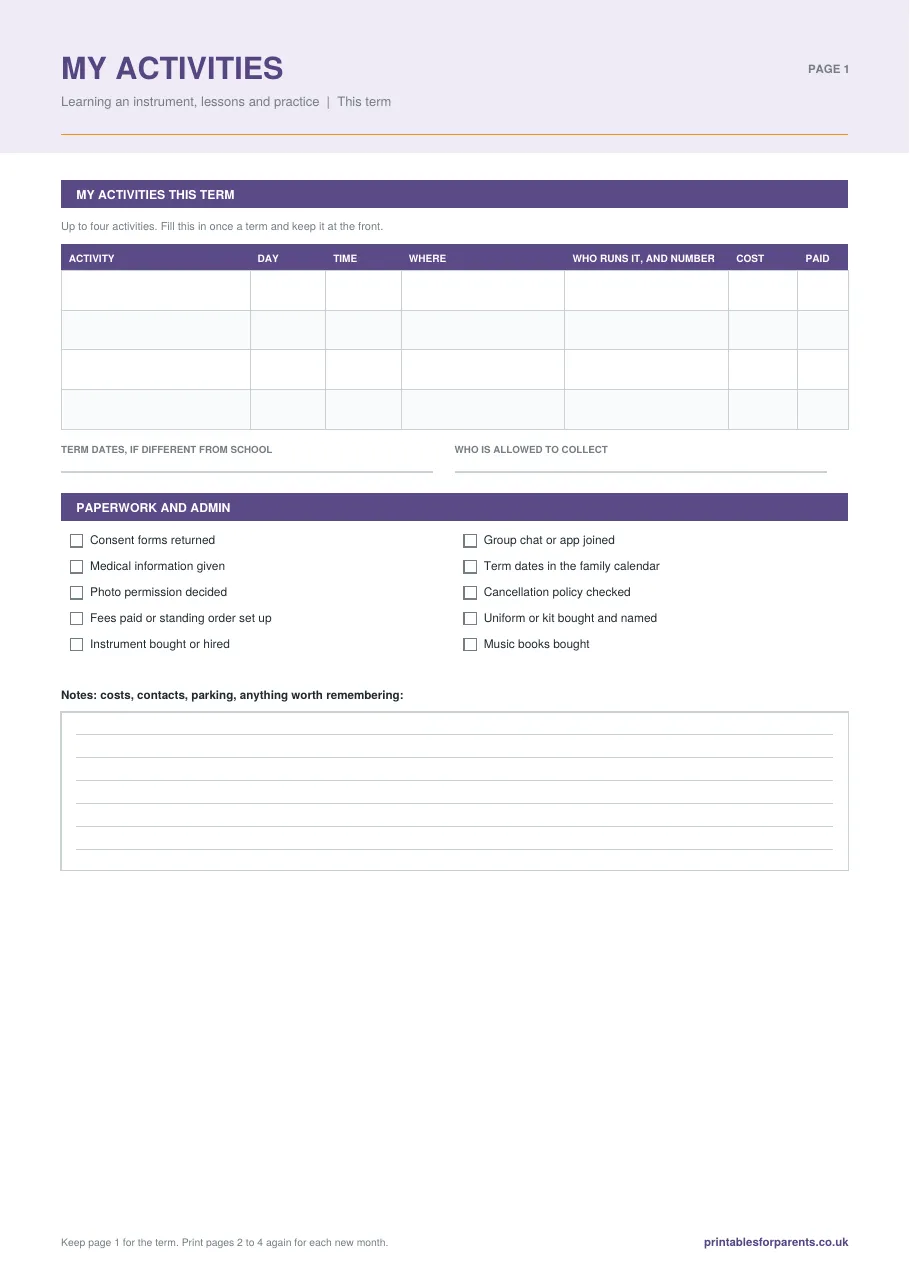
Free printable trackers for after school clubs and activities. One page a term for the timetable, costs and admin, then three pages a month for the week, the effort and the achievements. Music, dance, drama, coding, Scouts and Guides, and a blank one.
 5 sheets
Back to school checklists
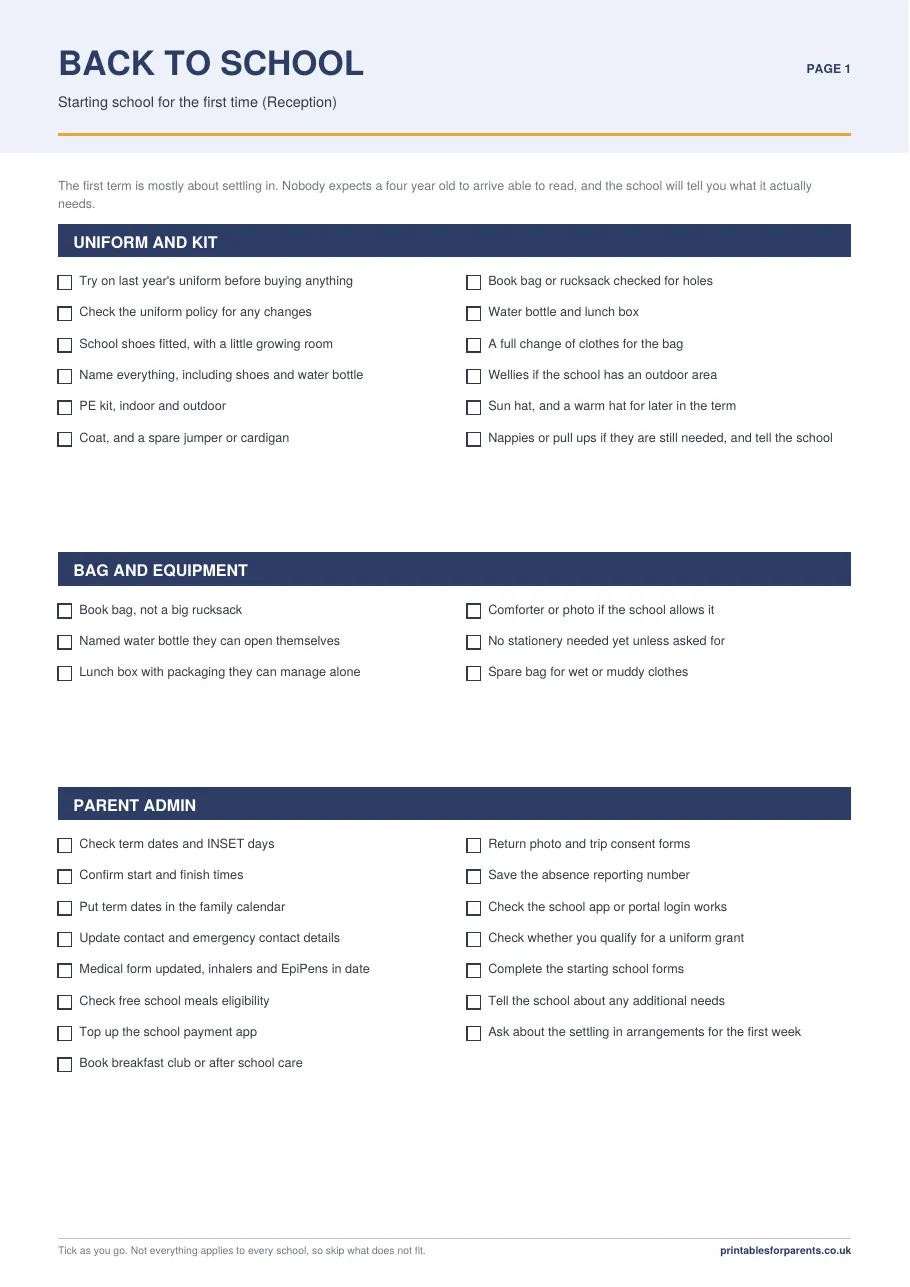
Free printable back to school checklists, one for each stage from starting Reception to the first week of secondary. Uniform, equipment, the parent admin, the routine reset and the conversations worth having first.
 7 sheets
Christmas planning sheets
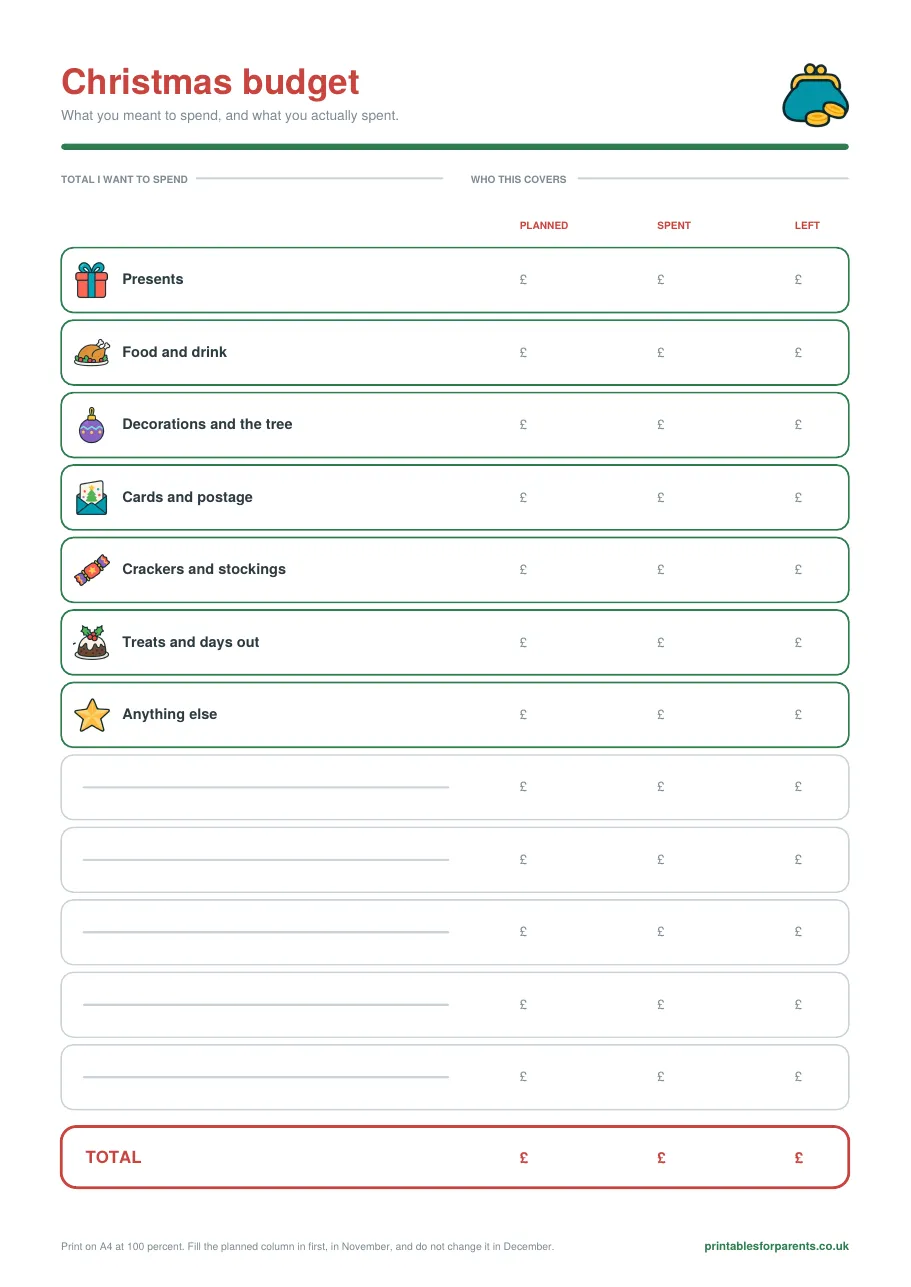
Seven free printable Christmas planners. A budget, a present tracker, a food plan, two advent calendars, a countdown chart and a letter to Father Christmas, all sized for A4.