Guide
What chores at what age
What children can realistically manage around the house at each age, how many jobs to put on a chart, whether to pay for them, and which jobs want an adult alongside.
Chores are one of those things nobody plans. You get to a point where you’re doing everything yourself, feel vaguely annoyed about it, and announce a new system on a Sunday evening. It lasts nine days.
The version that works tends to start smaller and earlier than that, and it helps to know roughly what’s reasonable to expect.
What’s reasonable at each age
These bands are convention rather than science. There’s no clinical guidance on when a child should be able to empty a dishwasher, and children vary enormously. Treat them as a starting point and adjust down without guilt.
Two to three. Everything happens alongside you and nothing happens reliably. Carrying their own cup to the kitchen, putting toys in a box, passing you things from the washing basket, fetching their shoes. The job is not the point at this age. Being included is the point, and a child who’s been handing you pegs since they were two finds a chore chart at seven much less of an insult.
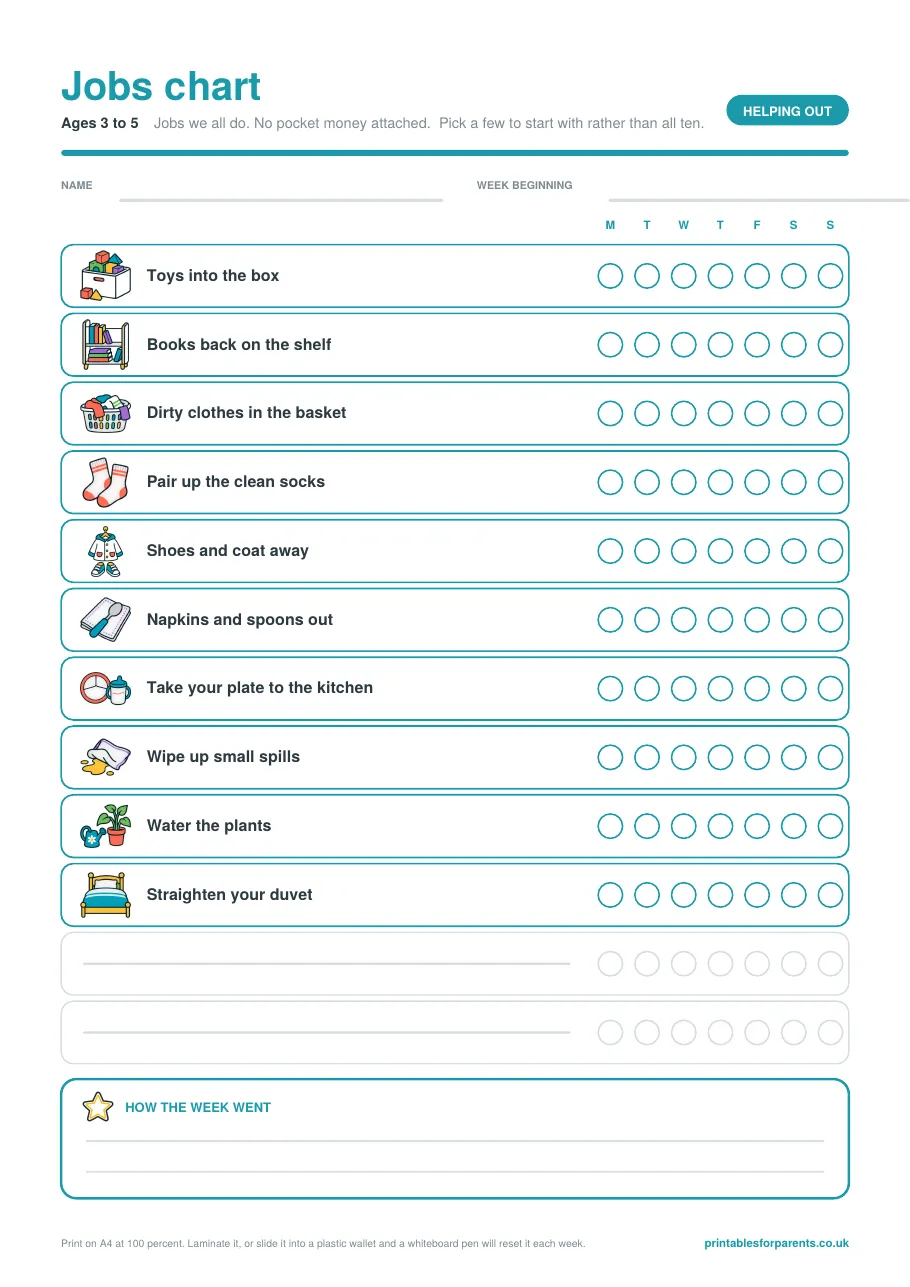
Three to five. Single step jobs they can finish on their own. Toys in the box, clothes in the basket, shoes by the door, helping lay the table. Finishing matters more than standard here. A table laid badly is a table laid, and correcting it in front of them is the fastest way to stop them offering.
Six to nine. Jobs with two or three steps, and the beginning of jobs they own rather than jobs they help with. Making a bed, clearing a plate, feeding a pet, tidying a room, packing a school bag. This is the age where the chart earns its keep, because they can read it and work through it without you standing there.
Ten to twelve. Genuinely useful work, and less frequent jobs that need remembering rather than just doing. Loading and emptying a dishwasher, taking bins out, stripping a bed on wash day, hoovering a room, sorting recycling, putting their own washing away. Many can make their own breakfast by now, which is worth more to you on a school morning than anything else on the list.
Thirteen and up. The aim shifts. It stops being about helping and starts being about being able to run a task end to end without supervision, because that’s the thing they’ll actually need. Cooking a simple meal, doing a load of washing from start to finish, doing a shop from a list.
Fewer jobs than you think
The most common mistake is a chart with ten things on it, which reads as thorough and is unmanageable.
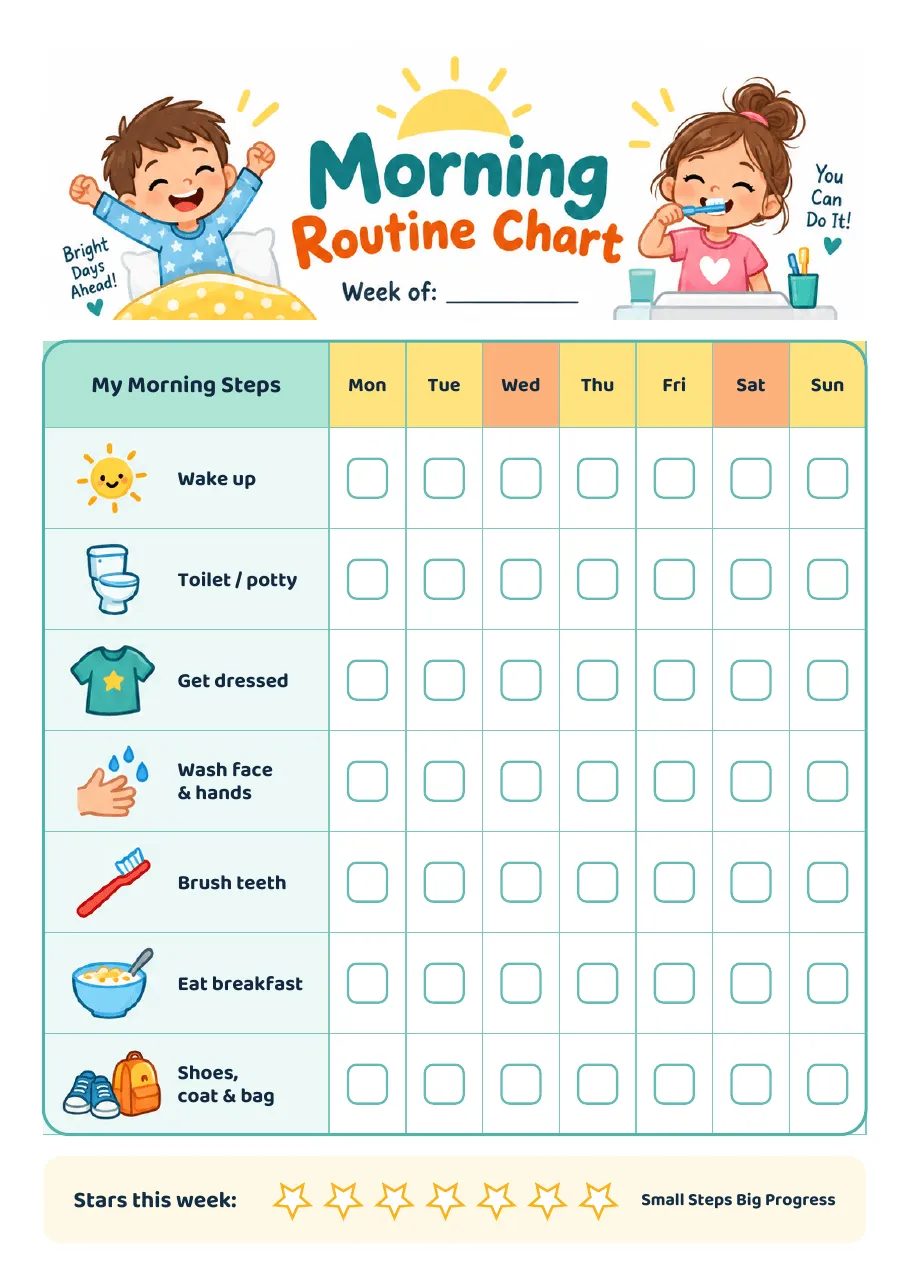
Four is plenty under about six. A chart that gets finished builds a habit. A chart that never gets finished is a weekly record of falling short, and small children read it exactly that way whatever you say about it.
If it’s going well after a month, add one. Adding one is easy. Taking six away once they’re printed feels like a climbdown and usually ends the whole experiment.
The money question
There are two defensible positions and no right answer.
Keeping chores unpaid treats them as what they are, which is the cost of living in a house with other people. Nobody pays you to empty your own dishwasher.
Attaching money to jobs does something different, which is teach a child that money arrives through work and runs out through spending. That’s hard to teach any other way, and a child who’s saved up for something over six weeks has learned something a lecture can’t deliver.
What goes wrong, in both camps, is pricing everything. Once every job has a figure, the unpriced jobs quietly stop happening, and you’ve taught the opposite of what you meant to. The usual fix is a short list that’s simply expected, with money attached to the bigger or less pleasant jobs on top of it.
The chore charts here come in both versions for that reason, with the same job lists, so you can run one, the other, or both.
Jobs that carry a condition
Three kinds of job need an adult in the room: heat at the cooker, sharp knives, and anything with a strong cleaner in it.
The instinct is to keep children away from all three until some unspecified later date, and that’s a mistake, because the later date never announces itself and you end up with a sixteen year old who can’t make a meal. The better version is to let them do the job with a condition attached, and to say the condition out loud every time until it’s obvious.
That last one matters more than people assume. RoSPA’s advice is that cleaning products should be stored high up or in a locked cupboard, kept in their original packaging, and put back straight after use, because young children are the group most at risk and products decanted into unlabelled containers lose both their warnings and their child resistant caps. A child old enough to be given a cleaning job is old enough to be told plainly why that bottle lives where it lives.
None of this means a ten year old can’t clean a bathroom. It means they clean it with a cloth and a spray you’ve handed them, not with whatever’s under the sink. On the chore charts here, that condition is printed under the job rather than left to be remembered.
When it stops working
It will. Most charts have a good fortnight and then fade, which is normal and not a sign that your child is uniquely difficult.
When it fades, cut the list rather than raise the temperature. One job, at a fixed moment in the day, done for a fortnight, puts you in a much better position than a full chart everybody is ignoring and arguing about.
And when a job has genuinely become automatic, take it off. A chart is scaffolding, and leaving something on it after your child does it without thinking converts a habit back into a transaction.
The measure that matters
Not a full chart. Whether they notice.
The point of all of it is a child who eventually registers that the bin is full, or that the table needs laying, without being told. That takes years and it arrives quietly, usually in a week when you’d given up on the whole idea.
Where this comes from
The age bands above are practical convention rather than clinical guidance, and children vary widely.
The advice on cleaning products follows RoSPA guidance on keeping children safe from accidental poisoning. If you’re worried about what your child can safely manage, their teacher, health visitor or GP knows them and this website doesn’t.
Common questions
What age should a child start doing chores?
Earlier than most people start asking them to. A two year old carrying their own cup to the kitchen is doing a chore, and the habit is far easier to build at that age than at nine, when it arrives as a new rule with no history behind it.
How many jobs should be on a chart?
Fewer than feels thorough. Four is plenty under about six. The number that works is the number your child can finish, because a chart that gets completed builds a habit and a chart that never does just sits there reminding everybody of it.
Should chores be linked to pocket money?
Families split on this and both approaches work. The thing that reliably goes wrong is pricing every single job, because the jobs without a price then stop happening. Most people who make it work keep a short list that's simply expected and attach money to the bigger things on top.
My child refuses point blank. What now?
Drop the number of jobs rather than raising the stakes. One job, done daily, at a fixed moment, rebuilds more ground than a chart full of things nobody is doing. Pick the one that matters least to you, so you can stay calm about it.
Which jobs are not suitable for children?
Anything involving bleach or strong cleaners, anything with a sharp knife, and anything at the cooker with heat on. Those want an adult alongside at an age you're best placed to judge, and cleaning products should be stored out of reach in the first place.