Guide
Starting reception, what actually matters
The year before school comes with a great deal of noise about what a four year old should be able to do. Here's what schools genuinely want, what they don't care about, and what's worth practising over the summer.
Somewhere around the spring before reception, the noise starts. Somebody’s neighbour’s child is reading. A relative asks whether they can write their name yet. A phone app promises to get them school ready in twelve weeks. I bought one of those, for the record.
Almost none of it is aimed at what schools actually ask for.
What reception teachers genuinely want
Ask one and the list is remarkably consistent, and remarkably practical.
Can they manage a coat, shoes and a lunch box? Not perfectly. But a class of thirty children who can’t get their own coat on eats a serious amount of teaching time, and a child who can do it feels capable rather than stuck.
Can they use the toilet and wash their hands? Including wiping, and including telling an adult when they need to go.
Can they ask for help from an adult who isn’t you? This is the big one. A child who will say “I can’t find my water bottle” to a teaching assistant is far better placed than one who will sit silently with a problem.
Can they sit and listen for a few minutes? Four or five, not twenty.
Can they take turns, more or less, some of the time? Nobody expects consistency at four.
Can they open their own lunch? Test the actual lunch box, and the actual yoghurt, in the actual kitchen, before September.
What they don’t expect
Reading. Writing sentences. Knowing phonics. Counting to a hundred. Being able to write their name neatly.
All of that’s what reception is for. Arriving already able to do it confers far less advantage than people think, and arriving unable to do it costs nothing at all.
Recognising their own name when they see it, on a peg or a tray, is worth rather more than being able to write it.
The summer, without turning it into school
Practise the boring physical things, because those are the ones that cause friction on day one.
Do up a coat. Put shoes on the right feet. Open the lunch box, the yoghurt, the crisp packet, the bottle. Carry a tray. Use a knife and fork. Wipe and wash hands. Say their own name clearly to somebody they don’t know.
For anything to do with writing, forget worksheets and do the physical work instead. Threading. Playing with dough. Peeling stickers. Cutting up junk mail with child scissors. Chalk on the patio. All of it builds the hand strength that pencil control needs, and children will do it for far longer than they’ll do a tracing sheet.
If you want tracing sheets as well, five minutes is plenty and stopping while it’s still fun matters more than finishing the page. The shape tracing and pre-writing packs are built for that, and the pre-writing lines are the ones doing the real work.
Talk about it, carefully
Ask what they’re looking forward to before you ask what worries them. It sets the frame, and you’ll get a better answer to the second question.
Take the worry seriously rather than reassuring it away. “You’ll love it” ends the conversation. “What bit are you not sure about?” continues it.
Tell them who to go to. By name, if you know it. A child who knows the name of one adult in the building is in a different position from one who doesn’t.
And tell them everybody else is new too, because a four year old genuinely doesn’t know that.
The first few weeks are about survival, not progress
Expect exhaustion. Expect a child who is fine all day and falls apart at 3.30, which is a compliment to the school rather than a complaint about it. Expect some regression, in sleep, in behaviour, occasionally in toileting.
Move bedtime earlier before term starts rather than after. Fifteen minutes every few nights for a fortnight works far better than one brutal Sunday.
Keep the first few weekends quiet. A child holding it together for five days has nothing left for a birthday party on Saturday.
The admin nobody mentions until it’s late
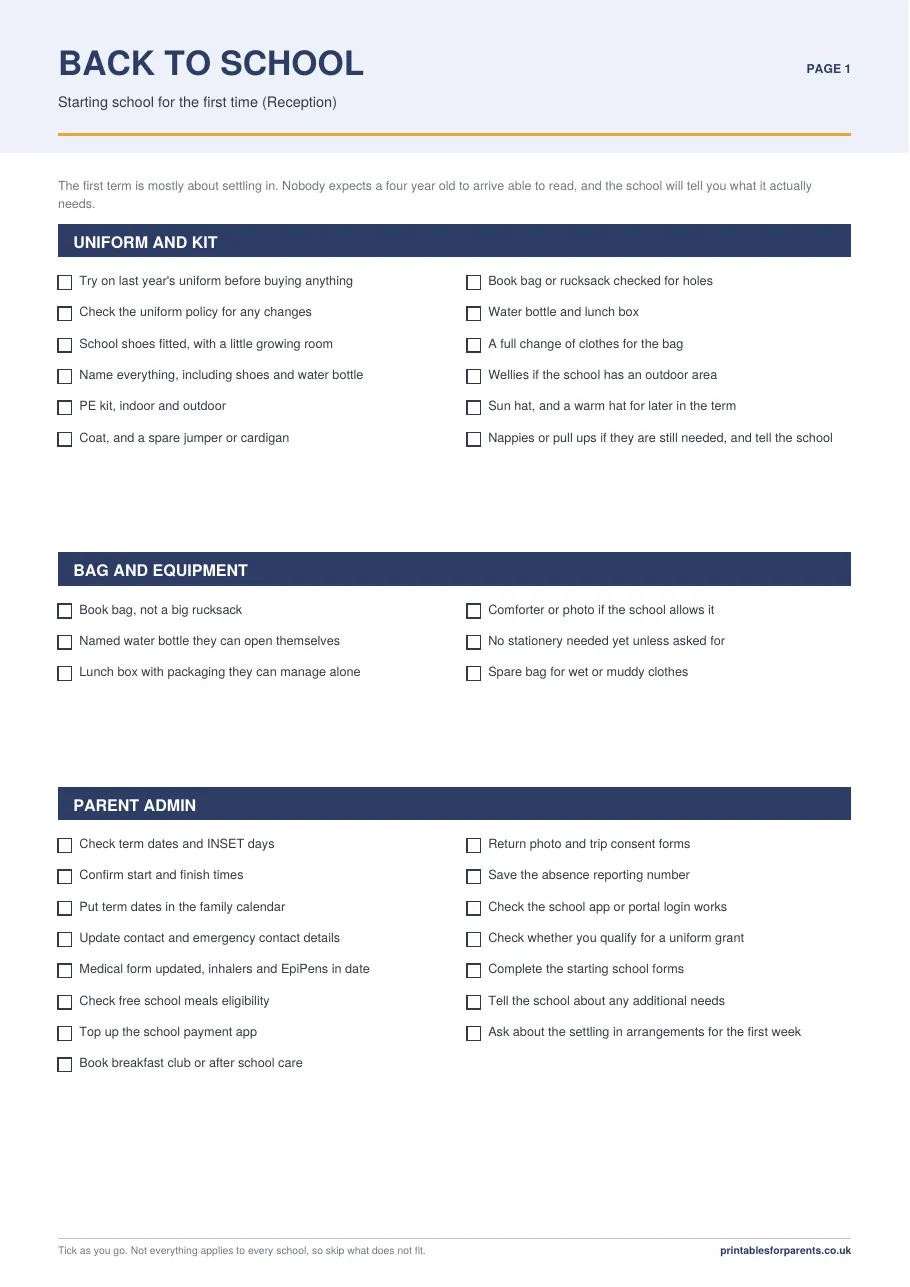
Uniform can be bought late and usually is. The paperwork can’t. Uniform grants, free school meals, the canteen payment account, medical forms, the school app that never logs in first time, breakfast or after school club places.
All of that has a process behind it and a queue in front of it in late August. Two or three weeks out is the right moment, and the back to school checklists have the whole list, with a separate sheet for starting reception.
One thing to hold on to
Reception teachers have done this many times. They have met the child who cries at the gate for three weeks and the one who never looks back, and they can tell you that the first group catches up entirely.
The first term is mostly about settling in. Nobody is measuring your four year old against anybody’s neighbour, and neither should you.
Common questions
Does my child need to read before reception?
No. Reading is taught in reception, and arriving able to read isn't expected. Schools would far rather have a child who can manage their own coat, ask for help and sit still for a few minutes than one who can decode words.
What about writing their name?
Nice if it happens, not required. Recognising their own name on a peg is more useful than writing it, and pencil control is taught in class. Five minutes of tracing is plenty at this age, and the physical play that builds hand strength matters more.
My child isn't toilet trained. Is that a problem?
It's common and schools deal with it every year. Tell them rather than hoping nobody notices. Settings must make reasonable adjustments, and a school that knows in July can plan for September.
How much does the summer birthday gap matter?
In reception it can be very visible, because an August child may be nearly a year younger than a September one in the same class. Good schools account for it. It's worth mentioning if you're worried, and worth remembering when comparing your child to classmates.