Guide
Is my child ready for handwriting and fine motor practice?
The skills that come before letters, what's normal at each age, when to start tracing and writing, and why pressure makes everything slower.
Every parent notices when other children their age are writing their own name. Then the anxiety arrives.
The spread of when children develop fine motor control is enormous. Some four-year-olds are writing sentences. Others are still scribbling at five and learning to write fluently by seven without ever having rushed it. Both are normal. The child who started later usually learned faster, because they had the coordination to do it efficiently.
What comes before letters
Handwriting isn’t the first thing. Before a child can form a letter, they need to control a pencil. Before they can control a pencil, they need the hand strength to hold one. Before that, they need to use their hands confidently.
The skills build in this order, and skipping steps makes everything harder:
Hand strength and coordination (birth to three) Threading, stacking, playing with dough, climbing, pouring water into containers, turning door handles, pushing buttons, opening boxes, playing with toys that have lids. Everything a young child does with their hands is building the muscle they will need later.
Gross motor control with mark-making (two to three) The moment they get a chunky crayon and make marks on paper. It doesn’t matter what the marks are. Scribbling, pressing hard, big circles, just enjoying the fact that moving their hand moves the page. This is where the real learning happens. They’re learning cause and effect and getting used to moving a tool under their control.
Line control (two to four) The ability to follow a path with a crayon or pencil. Not neatly. Just noticeably. A line that goes somewhat in the direction they intended. Waves and zigzags are harder than straight lines. Loops and spirals are harder still. There’s a reason the shape-tracing sheets start with lines and move through patterns before introducing shapes.
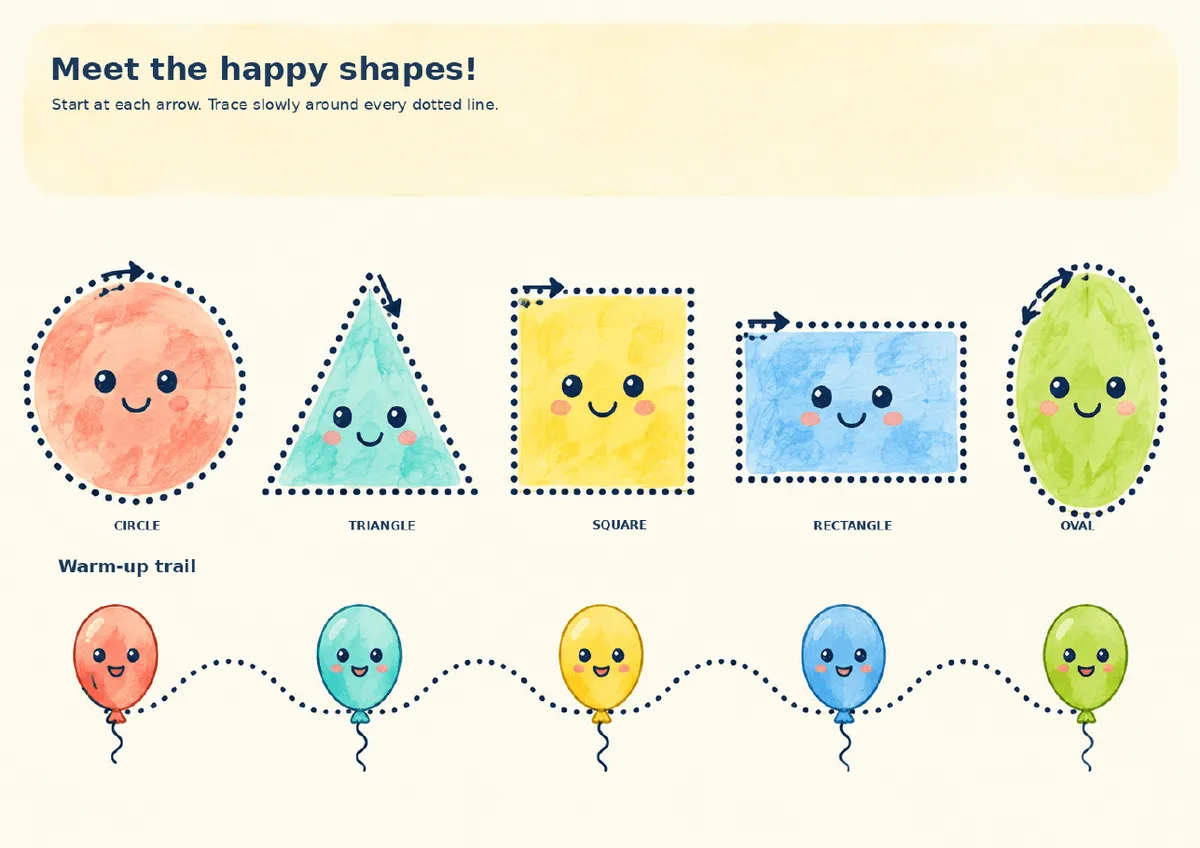
Shape recognition and copying (three to five) Drawing shapes, tracing them, spotting them in a picture. A circle is easier than a square. A square is easier than a triangle. None of it is automatic, and a child who can draw a circle with a recognisable round shape is doing something genuinely difficult.
Letter formation (four to six) Once the hand can do curves and lines and closed shapes, letters become possible. Most children aren’t ready to learn to write until they can do those shapes comfortably. Trying to teach a four-year-old to write an ‘a’ when they can’t yet draw a circle is like asking someone to run a marathon before they have learned to walk.
What’s normal at each age
Two to three years
Grip: usually the whole fist wrapped round the crayon.
What they do: scribble, in large loose marks across the whole page, sometimes pressing hard enough to break the crayon. Towards the end of this stage many children can copy a vertical line if they watch you draw one first.
When to worry: not at this age. If they’re interested in making marks, leave the paper out. If they aren’t, that’s fine too. There’s no hurry.
Three to four years
Grip: NHS guidance for this age describes holding a pencil with the thumb, index and middle fingers. It will still be loose and high up the pencil, and that’s normal.
What they do: copy a vertical line, a horizontal line and a circle, if they watch you draw it first. Draw a person with a head and a few other body parts, which usually arrives looking like a potato with legs. Many children can also cut along a straight line with scissors.
When to worry: some three-year-olds are still scribbling and some are drawing circles, and both sit inside the normal range. If your child shows no interest in making marks at all, mention it to your health visitor.
Four to five years
Grip: more settled, with the fingers doing the work rather than the whole arm.
What they do: copy lines, circles, crosses, squares and triangles. Write some letters, usually the ones in their own name first. Cut out a square and a circle. The order is fairly consistent: a cross at around four, a square a few months after that, a triangle closer to five.
When to worry: if your child can’t hold a crayon and make the marks they meant to make, mention it to your health visitor. If they can but won’t, stop pushing and come back to it in a month.
Five to six years
Grip: most children now hold a pencil in a way that looks close to an adult grip, though it may still be loose or high up.
What they do: writing letters and their own name, copying simple words, and some writing short sentences. Not neat, not consistent, but readable.
When to worry: if your child has shown no interest in writing by now, mention it to their teacher. They see a whole class of this age every day and can tell you whether it sits inside the normal spread.
Six to seven years
Most children are writing without thinking about it. They have stopped concentrating on forming each letter and started concentrating on what they want to say, which is the point at which writing becomes useful rather than an exercise.
When you can help
Let them see you write
Not a performance. Just writing a shopping list, a note, an email, something on a screen that’s visibly words and letters. Children who never see adults write have to take on faith that it’s useful. Seeing you reach for a pencil to jot something down does more than a worksheet ever will.
Make mark-making available
Paper, crayons, pencils on a table or in a basket. Not as a structured activity. As an option. When a child can choose to scribble while you’re doing something else, they do it for the joy of it rather than because you asked them to. That’s when the learning sticks.
Do some alongside them
Sit down with crayons and paper. Scribble. Draw a circle. Trace a line. You don’t have to be good at it. A child watching you attempt something and make a mess and carry on teaches them that mistakes are fine and trying is the point. Never comment on their work. Just do your own, quietly.
Use the sheets when they’re curious
The shape-tracing packs work best when a child has noticed that drawing is a thing they want to do. Pull them out when your child asks or when you’re sitting together doing mark-making anyway. Five minutes. Stop while it’s still fun. No finishing required.
Don’t fuss about grip too early
A toddler holding a crayon in a fist is doing exactly what a toddler does. By three or four, most children have moved to the thumb and first two fingers on their own, through practice rather than instruction. A child who grips hard is usually concentrating. If the grip still looks awkward once your child has started school, their teacher is the person to mention it to, because they will be teaching handwriting anyway and can see how your child manages in class.
When to pause
You’ve noticed your child can draw a shape. You’ve the tracing sheets. Everything is set up. The obvious next step is to sit down and work through them together.
Then your child cries or refuses or sits with the pencil in their hand and does nothing.
That’s the moment to stop.
A child who has decided pencil work is a battle will resist harder if you push. The fine motor skills are still building through everything else their hands do. Climbing, threading, cutting paper with child scissors, playing with plasticine, pouring and scooping. Leave the sheets in a drawer. Come back in four weeks.
When you come back, offer them once, casually, with no expectation. If the response is still no, wait another month. A child who is genuinely ready will be curious. A child who isn’t yet ready will resist, and pushing makes it take longer, not shorter.
The measure that matters
Not neatness. Not whether they know all their letters. Whether they will pick up a pencil without being asked.
Everything above is aimed at that. A child who wants to draw or write is a child who is learning efficiently. A child who has decided it isn’t for them yet will take longer to learn, even if you can force the early steps.
Pressure always, always makes handwriting take longer, not shorter. Curiosity and time make it take the right amount of time.
Where this comes from
The ages above follow the NHS development guide for three to five year olds from Buckinghamshire Healthcare NHS Trust, and the order in which children copy pre-writing shapes follows the pre-writing guidance from Somerset NHS Foundation Trust.
Children arrive at all of this on their own timetable and the spread is wide. This is general information rather than advice about your child. Your health visitor, GP or your child’s teacher knows them and this website doesn’t.
Common questions
What age should my child start handwriting?
There's no single right age. Fine motor development spreads wide, and a child who starts later usually takes less time overall because they have the coordination to learn efficiently. Readiness matters far more than the birthday.
My child just scribbles. Is that a problem?
Not in the slightest. Scribbling is the stage before control, and it's doing real work. The hand movements are building the muscle memory that letters need later. Leave the paper out, do some scribbling yourself, and resist turning it into something with a right answer.
Should I use lined paper or plain?
Plain paper first. Lined paper teaches children to confine themselves, but they need permission to be big and loose before that matters. Once they're comfortable with control, lines help. The [lined and grid paper](/lined-and-grid-paper/) sheets here are designed to move gradually from space to structure.
Pencil or crayon?
Start thick. A chunky crayon or a thick pencil in a small hand teaches gross motor control first. A sharp pencil usually produces a white-knuckle grip that's annoying to fix later, and there's no prize for getting to it first. Move toward thinner pencils as control improves, not before.
Should I correct how they hold the pencil?
Mostly it sorts itself out. NHS guidance describes children holding a pencil with the thumb, index and middle fingers somewhere around three to four, and that usually arrives through practice rather than instruction. A child who grips hard is normally concentrating. If the grip still looks awkward once your child has started school, raise it with their teacher.
My child refuses to trace or write. What now?
Stop for a few weeks. Come back to it without pressure. A child who has decided pencil work is a battle will resist harder if you push. The skills are still building through play, threading, cutting, climbing, and all the other things their hands do. Return to it when they're curious rather than when you're ready.