Nursery checklist and room planner
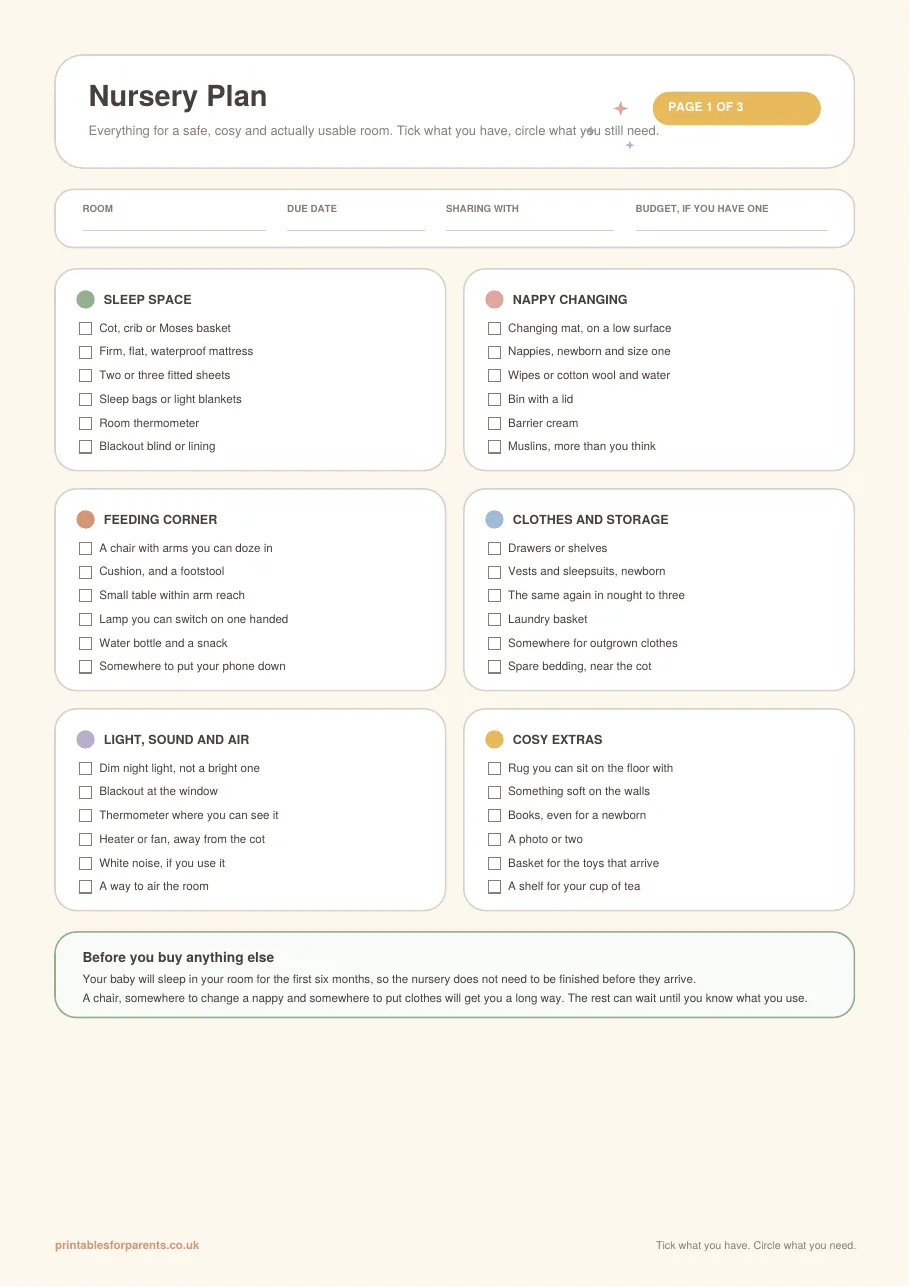
A free printable nursery checklist covering everything for a safe, cosy and usable room, a safer sleep check based on Lullaby Trust guidance, and a full page grid for planning where the furniture actually goes.
- Before the birth
- Before the birth
- Organisation
Also known as: nursery checklist, what do i need for a nursery, baby room checklist, nursery essentials, safe sleep checklist, nursery planner.
Buy less than the internet tells you to
Nursery lists exist mostly to sell nursery furniture, and they’re written as though the room needs to be photograph ready by 38 weeks. It doesn’t.
We bought a changing table, a Moses basket and a nursing chair. Two of the three earned their place. Your baby will sleep in your room for the first six months. What you genuinely need ready is somewhere for them to sleep, somewhere to change a nappy at a height that won’t wreck your back, somewhere to put clothes, and a chair you can doze in. The rest can wait until you know what you actually reach for.
The list is written for three in the morning
Which is why it includes a lamp you can switch on one handed, a small table within arm’s reach, somewhere to put your phone down, and a shelf for a cup of tea. None of those appear on a shop’s list and all of them matter more than a nursing chair in the correct shade of sage.
Muslins, incidentally, more than you think. Everybody says it and everybody is right.
The safety page takes ten minutes and then you’re done
Seven safer sleep points, taken from Lullaby Trust guidance: on their back for every sleep, a clear cot with no bumpers, pods, nests or toys, a firm flat waterproof mattress that fits snugly, feet to the foot of the cot, a room between 16 and 20 degrees measured with a thermometer, your room for the first six months, and a smoke free home.
Then the room itself. Blind cords, furniture anchored to the wall, the monitor cable well away from the cot, nothing hanging above it.
Second hand, and where to draw the line
Most of it is fine and some of it isn’t, so the sheet says which is which. A cot is fine with its safety label and all its parts, provided nothing wobbles. A mattress is better new for each baby where you can manage it, and if you’re reusing one it needs to be firm, flat, free of tears and properly cleaned.
Blinds are the one people forget. If you’re buying second hand, or inheriting a room, choose one with no looped cord at all rather than trying to make a loop safe.
Pods, nests and cot bumpers aren’t a bargain at any price, because they shouldn’t be in the cot in the first place.
Draw the room before you build anything
Page three is a full page grid at roughly 20cm a square. Mark the door, the window, the radiator and the sockets first, then put the cot wherever is left.
It sounds fussy until you have assembled a cot in the only spot it fits and then discovered the radiator is behind it.
Where the safety advice comes from
The same clear cot rule is why the high contrast baby cards belong on a wall rather than in the cot, if you are printing those too.
The safer sleep points follow The Lullaby Trust and the NHS, checked in August 2026. It’s general information rather than advice about your baby. Your midwife and health visitor know your family, and the Lullaby Trust runs a free information line for questions about your own setup.
1 free nursery checklist and room planner to print
Every sheet is a PDF sized for A4. Tap a design to download it. No sign-up, no watermark.
Nursery checklist and room planner
Three pages. Six categories of what you actually need, a safer sleep and room safety check, and a full page grid for the layout.
Printing and using it
- Three pages. The shopping side, the safety check, and a full page grid for planning the layout.
- Print page three on its own if you're working out where the cot goes. One square is roughly 20cm, so a normal bedroom fits comfortably.
- Take page one with you when shopping, or send a photograph of it to whoever keeps asking what you need.
Common questions
How much of this do I need before the baby arrives?
Less than you think. Your baby will sleep in your room for the first six months, so the nursery doesn't have to be finished. A chair, somewhere to change a nappy and somewhere to put clothes will carry you a long way.
What shouldn't go in the cot?
Pillows, duvets, cot bumpers, pods, nests, wedges, rolled towels and toys. The Lullaby Trust is unambiguous about this: a baby needs a firm flat waterproof mattress and lightweight bedding, and nothing else.
What room temperature should the nursery be?
Between 16 and 20 degrees, checked with a room thermometer rather than guessed. Overheating raises the risk of SIDS, so slightly cool is safer than slightly warm.
Is second-hand nursery furniture safe?
A cot usually is, provided it carries a safety standard label, has all its parts and nothing wobbles. A mattress is better new for each baby where you can manage it, and if reused it must be firm, flat, free of tears and thoroughly cleaned. Pods, nests and cot bumpers aren't a bargain at any price, because they shouldn't be in the cot at all.
Why is there a page for drawing the room?
Because the cot needs to be clear of the window, the radiator, the curtains and any blind cord, and that's far easier to discover on paper than with a wardrobe in your arms.
Printables that go with these
 2 sheets
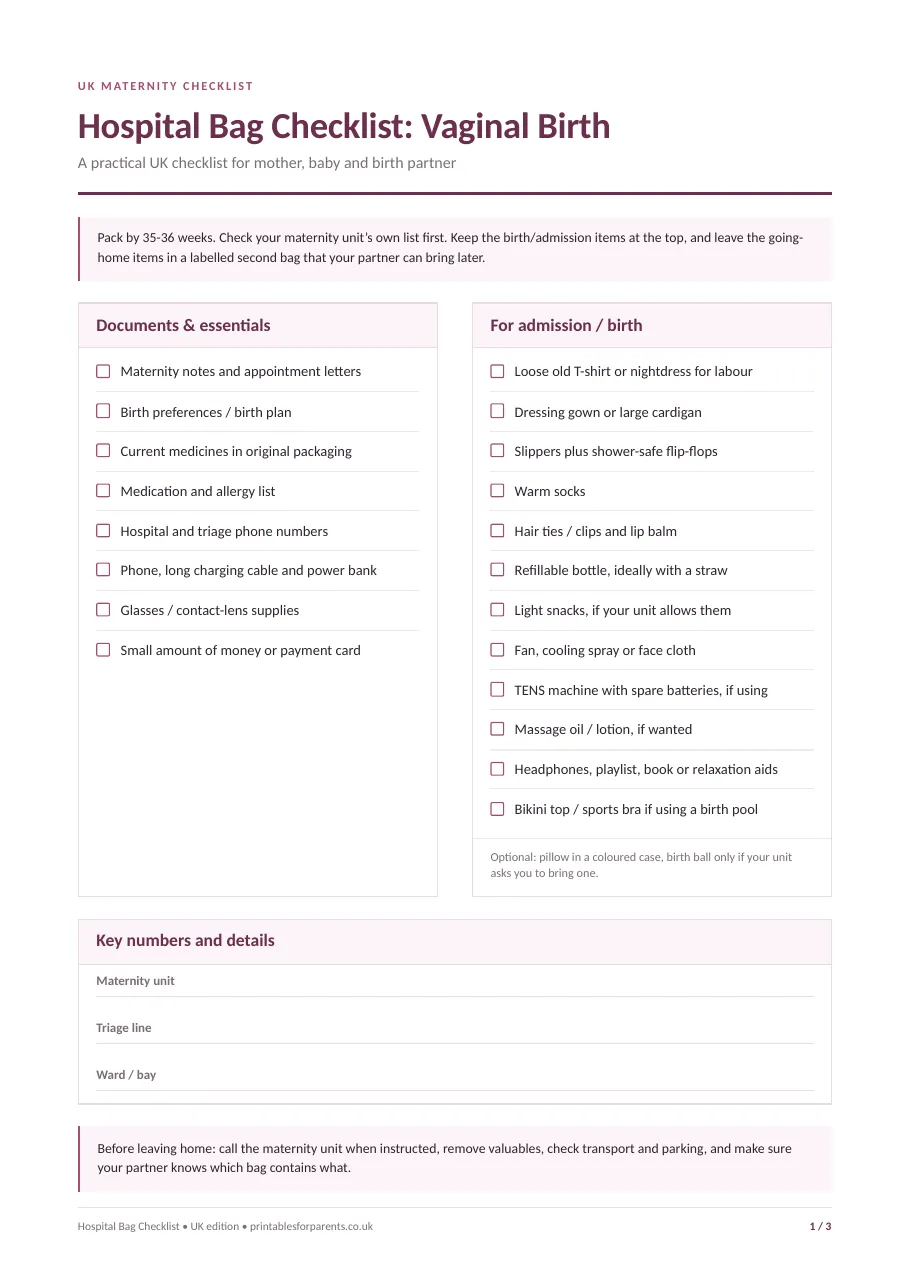
Hospital bag checklists
Two free printable UK hospital bag checklists, one for a vaginal birth and one for a caesarean. Three pages each, covering you, your baby, your birth partner and going home.
 1 sheet
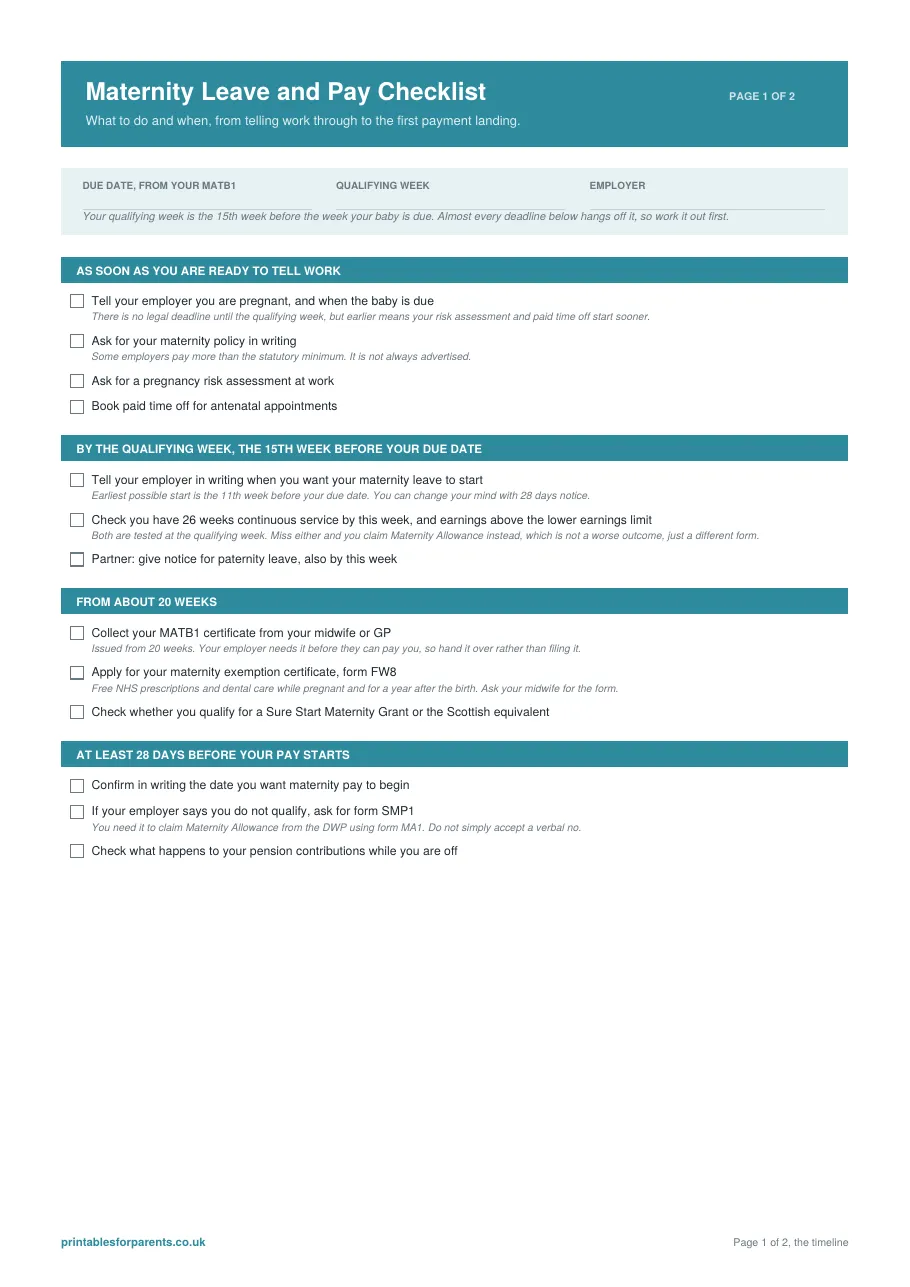
Maternity leave and pay checklist
A free printable checklist for UK maternity leave and pay. What to tell work and when, the deadlines that hang off your qualifying week, and a page for the dates and figures so you can check your payslips against something.
 1 sheet
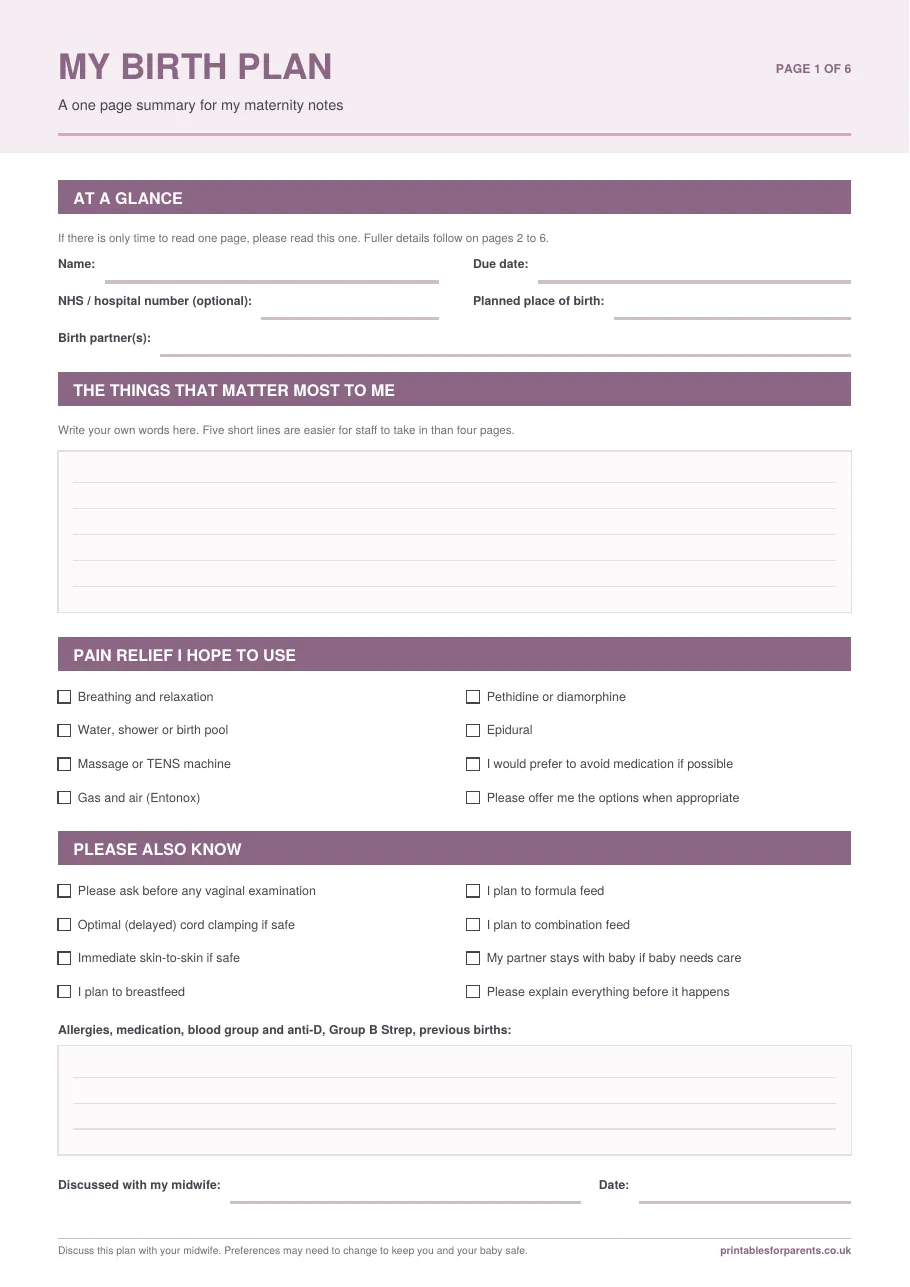
Birth plan template
A free printable UK birth plan template. Six A4 pages, with a one page summary at the front for your maternity notes and fuller sections behind it, including what you would like if labour is induced or you need a caesarean.
 1 sheet
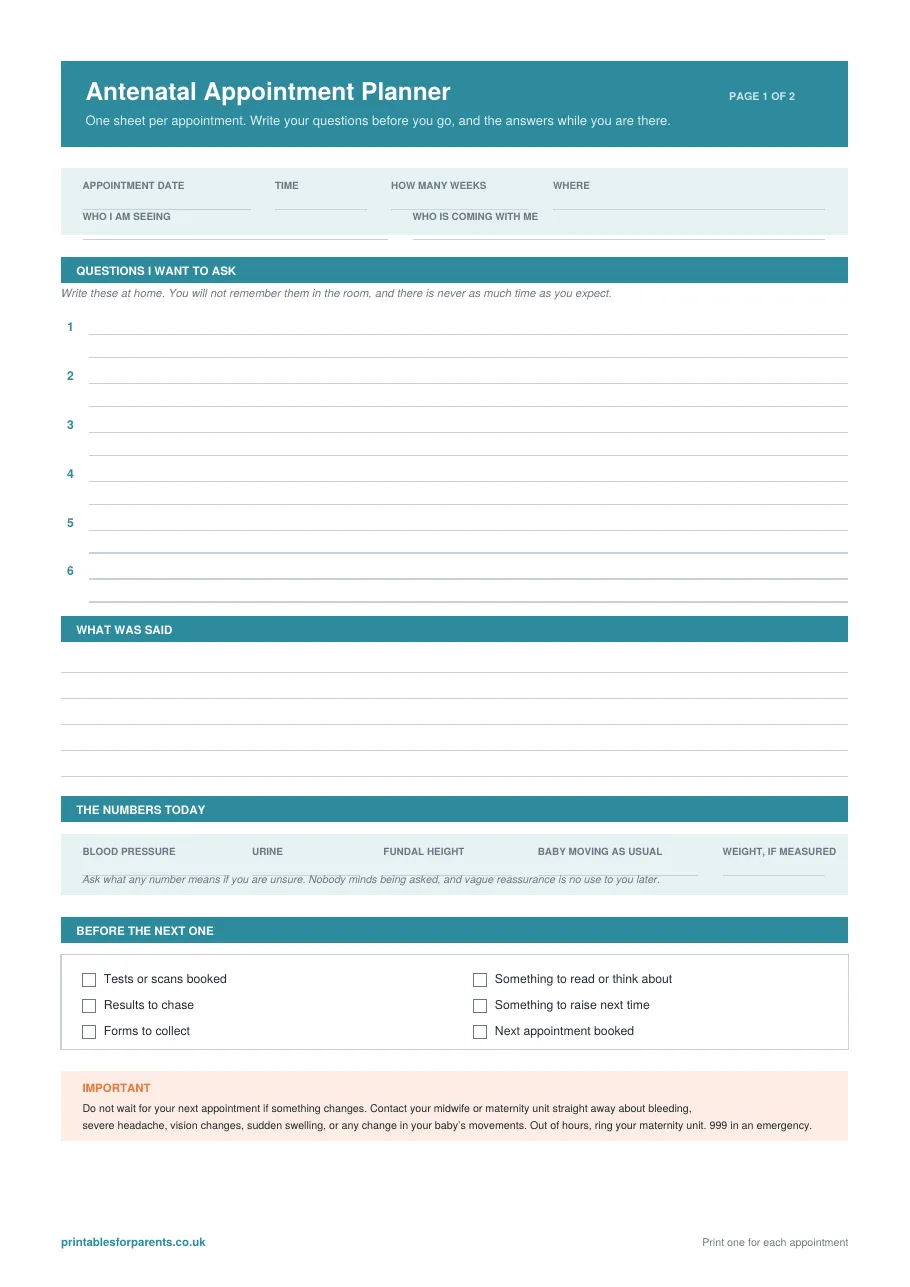
Antenatal appointment planner
A free printable planner for your antenatal appointments. One sheet per appointment for the questions you meant to ask, plus a page holding the whole schedule so you can see what's booked and what isn't.