Guide
Is my child ready for potty training?
The signs that suggest a child is ready to start potty training, the ones that mislead parents, and why starting late almost never costs anything.
Almost every parent asks this question a few weeks before the answer is yes. The urge to start usually comes from outside: a nursery place, a friend’s child, a comment from a relative. We started ours because of a nursery place and were back in nappies within a month, so I would say that’s the worst reason to begin.
Signs that genuinely suggest readiness
- Staying dry for longer stretches. A nappy that’s dry after a nap, or dry for a couple of hours, suggests the bladder is developing the capacity for this.
- Telling you. Not just afterwards, but noticing at the time, or just before. This is the big one, and it usually arrives last.
- Wanting to be changed. An objection to a dirty nappy is a useful sign that they have registered the difference.
- Being able to manage the practical part. Walking to the potty, getting trousers down, sitting and staying there for a minute.
- Interest. Following you to the bathroom, asking about it, wanting to try.
You don’t need all of them. Two or three, present consistently for a couple of weeks, is a reasonable place to start.
Signs that mislead
Age on its own tells you very little. Nor does a sibling’s timetable, or the fact that a friend’s child managed it at two. Children arrive at bladder control on their own schedule and the spread is wide.
Being able to say the words isn’t the same as being able to do the thing, and a child who happily sits on a potty as a game isn’t necessarily ready to use it.
Bad weeks to start
A new baby, a house move, starting nursery, a bereavement, a stretch of illness, or a period of constipation. Any of those makes a difficult job harder, and pushing through tends to produce a longer overall process rather than a shorter one.
Waiting a month costs almost nothing. Starting during a bad fortnight can cost several.
What starting looks like
Clear a few days where you’re mostly at home. Loose clothes, no nappy during the day, potty in the room you’re actually in. Offer regularly and calmly rather than asking constantly. Expect accidents. They are how this works, the whole way through.
If it’s plainly not working after a week or so, stop. Put nappies back on without making it a defeat and try again in six weeks. Children who are given that break almost always come back and get it quickly.
When to ask for help
Speak to your health visitor or GP if there’s pain, blood, long-standing constipation, no progress at all after several genuine attempts, or a child who was reliably dry and has gone back to accidents for weeks. Those are worth a conversation, and none of them is a discipline problem.
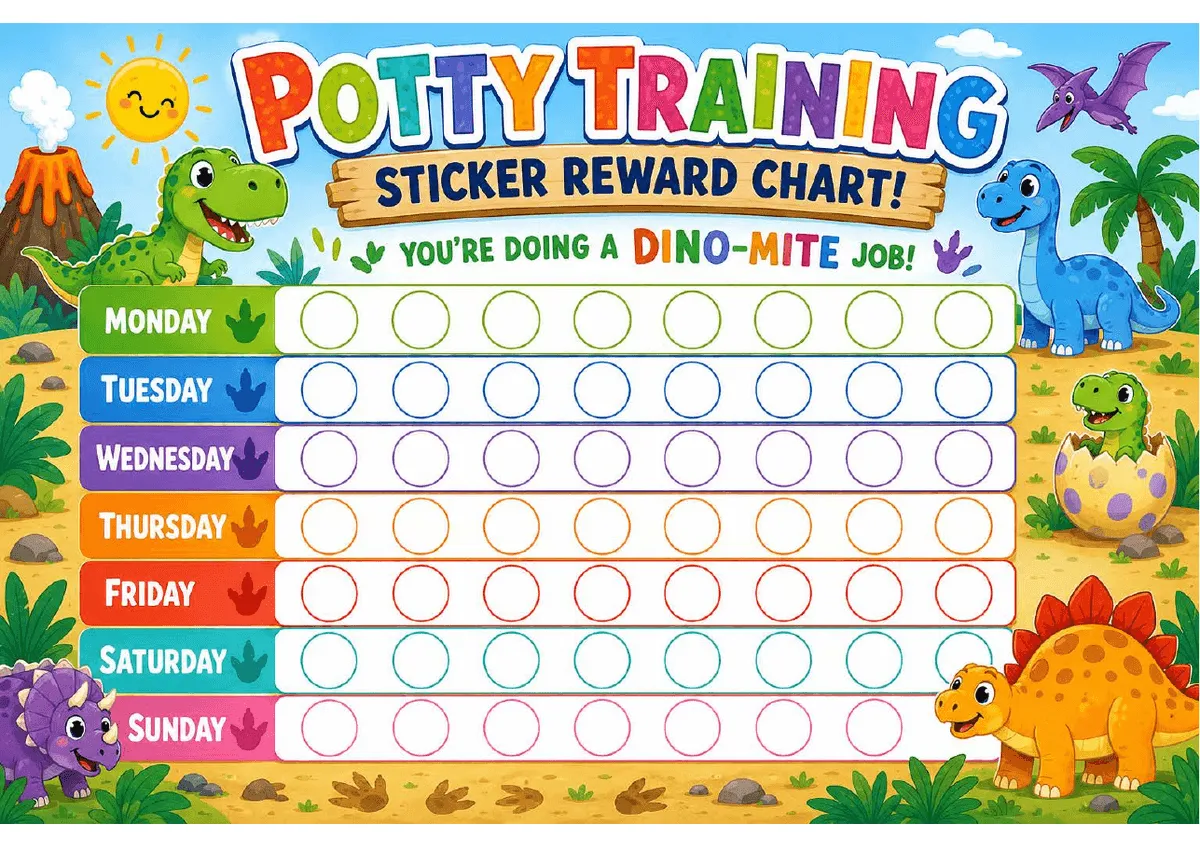
If you’re ready to start, the potty training charts are free to print, though plenty of families manage entirely without one.
Common questions
Is there a right age to start?
There's a wide normal range and no single right age. Readiness matters more than the number, and children who start later usually take less time overall.
Nursery says they should be out of nappies. What now?
Ask what specifically they need and by when, and tell them where your child is up to. Most settings are used to this and would rather work with you than have a child who isn't ready.