Guide
Christmas with small children without overspending
Where the money actually goes at Christmas, why young children do not rank presents the way adults assume, and the handful of decisions that change what December costs.
Most people do not overspend at Christmas by making one dramatic decision. They overspend eight pounds at a time, across six weeks, on about forty separate occasions, and then wonder in January what happened.
That is worth knowing because it tells you where to look.
The money is not where you are watching
Presents are the line everybody watches, which is exactly why they are rarely the problem. People set a figure per child, more or less stick to it, and feel they have done the sensible thing.
Then there is the food, the tree, the decorations to replace the ones that broke, the cards, the stamps, the crackers, the advent treats, the school fair, the nativity costume, the second roll of wrapping paper because the first ran out, the days out because the children are off, and the takeaway on the twenty third because nobody can face cooking.
None of those feels like a decision. All of them are.
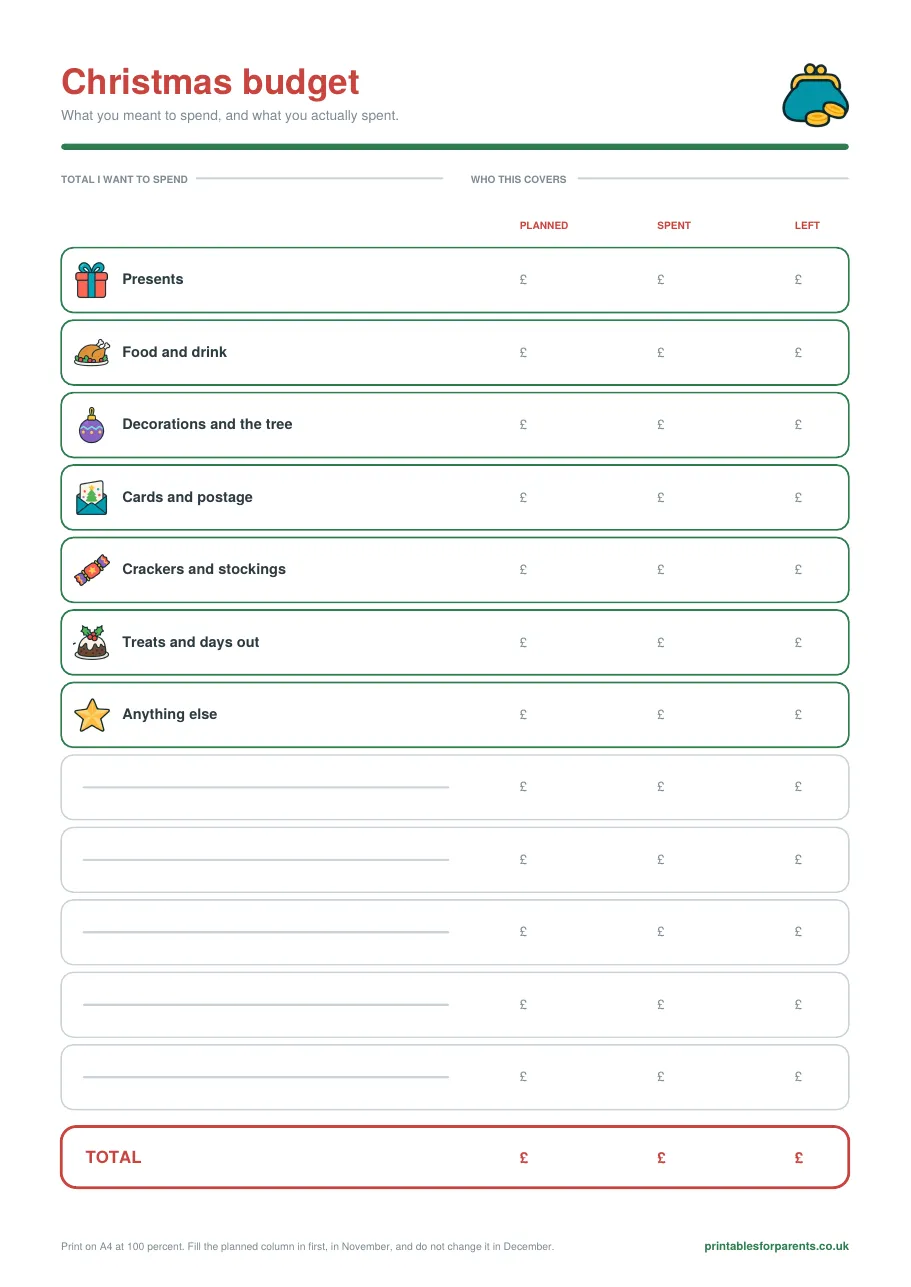
The Christmas budget sheet has seven categories on it for this reason. The point of writing presents, food, decorations, cards, crackers, treats and anything else in separate rows is that the total stops hiding.
Pick the number in November
The single most useful thing you can do is choose what Christmas costs while it is still weeks away.
A figure chosen in November is a decision. The same figure chosen on the eighteenth of December, in a shop, with a child who has just mentioned something, is not a decision at all. You are not weaker in December, you are just operating with less time and more pressure, which produces the same result.
Write it down. Put the planned column in before the spending starts, and then resist the urge to tidy the number up later to match what happened.
What small children actually respond to
This is the part most people find hard to believe until they watch it happen.
Children under about six are genuinely poor at valuing things. They do not know what anything cost, they have no reliable sense of which present was the expensive one, and the thing that gets played with on Boxing Day is frequently not the thing you worried about. The box is a cliche because it keeps being true.
What they do read, extremely well, is the mood of the adults. A quieter Christmas with a parent who is not braced for the credit card bill is a better Christmas, and they pick that up without being able to say so.
None of this means spend nothing. It means the relationship between money and how good it was is far weaker than it feels in the shop.
The advent trap
Twenty four days of a bought treat is one of the quietest ways December gets expensive, and it sets an expectation that is difficult to walk back the following year.
The alternative is not nothing, it is doing something. Make a paper chain. Read a Christmas story. Walk round after dark and count the houses with lights up. Pyjamas all day. Choose a toy to give away. Bake something.
The filled in advent calendar has twenty four of these on it and almost all of them cost nothing, which is the whole point of printing it rather than buying one.
Say it out loud, early
Presents between adults, and presents for other people’s children, both creep because nobody wants to be the one who raises it.
Somebody has to, and November is when it is easy. A short message suggesting the children only, or a limit, or nothing at all this year, is almost always met with relief, because the other family was thinking it too. The same conversation on the twentieth of December is impossible, which is why it never happens then.
The food is a separate problem
Christmas food goes wrong in the same way the weekly shop goes wrong, by buying for a version of the day that never arrives. Most of what gets thrown away in the first week of January was bought in case.
Cook what your family actually eats. The number of people who buy a vegetable at Christmas purely because it is traditional, cook it, and then throw it away, is remarkable.
Everything in how to cut a family food bill applies here and applies harder, because the quantities are bigger and the planning window is shorter. The food plan sheet has a make ahead box on it, which is the part that saves Christmas morning rather than money, and is worth filling in anyway.
What to cut first, if you have to
In rough order of least missed.
Wrapping paper, which gets destroyed in nine seconds. Cards for people you will see in person anyway. The second and third day out. New decorations, when the ones in the loft are fine. Crackers, which cost more than they look and contain a joke nobody reads.
What not to cut first is the thing your family does every year, whatever it happens to be, because the tradition is doing more work than its price suggests.
And then January
Buy next year’s wrapping paper, cards and decorations in the sales. It is dull advice and it is the easiest money on this page.
Do not buy next year’s presents in January. You cannot know what a four year old will want in eleven months, and the ones bought early tend to get forgotten in a cupboard and bought again.
If you want the sheets that go with all this, the Christmas planning printables cover the budget, the presents and the food, and the colouring pages and crafts are the free end of keeping children busy in December.
Common questions
How much should I spend on each child?
There is no right figure, and anyone who gives you one is guessing about your house. What matters more is that you chose the number in November when you were calm, rather than in the third week of December standing in a shop.
Will my child notice if we spend less?
Less than you fear, particularly under about six. Small children are poor at valuing things and very good at noticing how the adults are behaving, so a cheaper Christmas with a relaxed parent in it usually lands better than an expensive tense one.
What is the biggest hidden cost?
The drip. Not the presents, which people watch, but the fortnight of small extras, the second tube of wrapping paper, the going out because it is Christmas, the trips, and the twenty four treats in the advent calendar.
How do I handle presents for other people's children?
Agree it out loud and early, before anyone has bought anything. Most families are relieved when somebody else raises it, and a text in November is easy where the same conversation on the twentieth of December is not.
Is it worth buying in a sale in January?
For wrapping paper, cards and decorations, yes, and it is the single easiest saving available. For presents it is less useful, because you cannot know in January what a four year old will want next December.