Guide
How to write a birth plan that works for you
A birth plan isn't a contract and you can't fail it. What to think about before you fill one in, the four decisions that shape everything else, and how to plan for the parts that don't go to plan.
Most birth plan advice hands you a checklist and wishes you luck. That’s fine as far as it goes, but a tick list can’t tell you which boxes matter for your birth, in your hospital, with your history. This guide is about the thinking behind the plan, so that when you sit down with the template you already know what you want and why.
I wrote mine three times and the third one was a single side of A4. Grab a cup of tea, this one is worth doing properly.
First, the reassuring bit
A birth plan is a record of what you would like to happen during labour, birth and afterwards. That’s all it is. The NHS is clear that you don’t have to write one, that your midwife will help if you want to, and that you can change your mind about any of it at any time.
It carries no obligation, there is nothing in it you can get wrong, and it promises nothing at all about how the day will actually go, because birth has never once read the paperwork.
What it is, is a way of making sure the people caring for you know who you are and what matters to you, at a moment when you may not feel like explaining yourself.
Why bother, if it might all change anyway
Because the real value isn’t the piece of paper. It’s the conversation.
Writing a plan forces you to find out what your options actually are, which means you arrive at your appointments with questions rather than vague worries. Your midwife gets the chance to explain what’s available where you’re giving birth, what your history means for your choices, and what usually happens in practice.
There’s also a less comfortable reason. Feeling unheard and out of control is one of the things people most often describe when a birth has left them distressed afterwards. Having thought your preferences through in advance, and having them written down where staff can see them, is one of the few things within your control that helps with this.
Start with your why, not the checklist
Before you tick a single box, try writing three sentences.
- What would make me feel safe in labour?
- What am I most worried about?
- If everything changed tomorrow, what would still matter to me?
Someone who answers “I panic when I don’t know what’s happening” ends up with a very different plan from someone who answers “I want as little medical involvement as possible”. The first person needs a plan built around explanations and being kept informed. The second needs one built around mobility, environment and declining routine offers. Both are perfectly good plans. They just aren’t the same plan, and a generic checklist won’t tell you which one you’re writing.
The decisions that shape everything else
Four choices do most of the work. The rest is detail.
1. Where you give birth
NICE recognises four settings for anyone at low risk of complications: at home, in a freestanding midwifery unit, in an alongside midwifery unit (attached to a hospital), and in an obstetric unit. You’re entitled to be offered all four, and to be given your local outcome figures to help you choose.
The setting genuinely changes what’s likely to happen to you. These are the figures NICE uses, drawn from the Birthplace in England study, shown as the number of women per 1,000 for each planned place of birth.
If this is your first baby
| Outcome (per 1,000 women) | Home | Freestanding unit | Alongside unit | Obstetric unit |
|---|---|---|---|---|
| Spontaneous vaginal birth | 794 | 813 | 765 | 688 |
| Forceps or ventouse | 126 | 118 | 159 | 191 |
| Unplanned caesarean | 80 | 69 | 76 | 121 |
| Epidural or spinal | 218 | 200 | 240 | 349 |
| Transferred to an obstetric unit | 450 | 363 | 402 | 10 |
If you have given birth before
| Outcome (per 1,000 women) | Home | Freestanding unit | Alongside unit | Obstetric unit |
|---|---|---|---|---|
| Spontaneous vaginal birth | 984 | 980 | 967 | 927 |
| Forceps or ventouse | 9 | 12 | 23 | 38 |
| Unplanned caesarean | 7 | 8 | 10 | 35 |
| Epidural or spinal | 28 | 40 | 60 | 121 |
| Transferred to an obstetric unit | 115 | 94 | 125 | 10 |
Two honest caveats. First, for a first baby, planning a home birth carries a small increase in the risk of a poor outcome for the baby compared with the other settings, although the absolute risk stays very low in every setting. NICE says this plainly and so should anyone quoting these tables at you. Second, look at that transfer row. Nearly half of first time mothers planning a home birth end up moving to an obstetric unit, so if you choose home, plan for transfer as a realistic possibility rather than a failure.
If you have given birth before, the picture is different enough to be worth a second look.
2. What happens if your labour is induced
Roughly a third of labours in England are now induced, and the figure has been climbing for well over a decade. What the national average hides is how much units vary. A survey of 54 UK maternity units found induction rates ranging from about 19% to over 53%, with a median of 36%.
That variation is the single most useful thing to know here, because it means the likelihood of being offered an induction depends partly on where you’re booked. Ask your unit for its own rate. It’s a fair question and they should be able to answer it.
An induction plan doesn’t need to be complicated. It needs to cover: what you want explained before you agree, whether you want a membrane sweep offered or not, whether you want to stay mobile between examinations, and which parts of your original plan you would still like to keep (music, dim lights, a pool later on if one becomes free).
3. What happens if you have a caesarean
In 2024/25, 45% of NHS deliveries in England were by caesarean. Planning for one isn’t pessimism. It’s arithmetic.
Write this section whether or not a caesarean is on the cards for you. If yours is already booked, you have time to think about the extras: a quiet theatre so your voice is the first your baby hears, the screen lowered at the moment of birth, your arms left free, immediate skin to skin, your partner doing skin to skin if you can’t. If it happens unexpectedly, those same preferences are still available to you, and having them written down means someone can advocate for them while you’re otherwise occupied.
4. Pain relief and monitoring
Rather than committing to one method, it usually works better to note the order you would like to try things in, and how you want to be offered them. Some people want everything offered proactively. Others want to be left alone unless they ask. Both are worth writing down, because staff can’t guess.
The same applies to monitoring and vaginal examinations. Intermittent monitoring, where it’s suitable, leaves you far freer to move. Examinations are offered, not compulsory, and you can ask for them to be limited, or ask to be told what was found.
Plan for the plot twists
The best sections of any birth plan are the ones headed “if”. If labour is induced. If an assisted birth is recommended. If I need a caesarean. If my baby needs care elsewhere. If I need to transfer.
These are the moments when things move quickly and you’re least able to explain what you want. A few lines written calmly at 34 weeks does more for you than four pages about candles.
Include what you would like to happen to the rest of your plan when one part of it changes. “If I need an epidural, I would still like to try upright positions for pushing” is a genuinely useful sentence.
You’re allowed to say no
This is the part nobody tells you clearly enough, so here it is.
Nothing can be done to you without your consent. In Montgomery v Lanarkshire Health Board (2015), the Supreme Court confirmed that an adult of sound mind decides which treatments, if any, to undergo, and that you must be told about the risks that are relevant to you, not just the ones a clinician thinks are important.
In practice, that means you can ask, at any point:
- Benefits. What are the benefits of what you’re suggesting?
- Risks. What are the risks?
- Alternatives. What else could we do?
- Instinct. What does my gut say?
- Nothing. What happens if we do nothing, or wait an hour?
Being informed isn’t the same as being difficult. A good midwife will welcome the questions.
Keeping it usable
- Write it before 37 weeks, or earlier for twins.
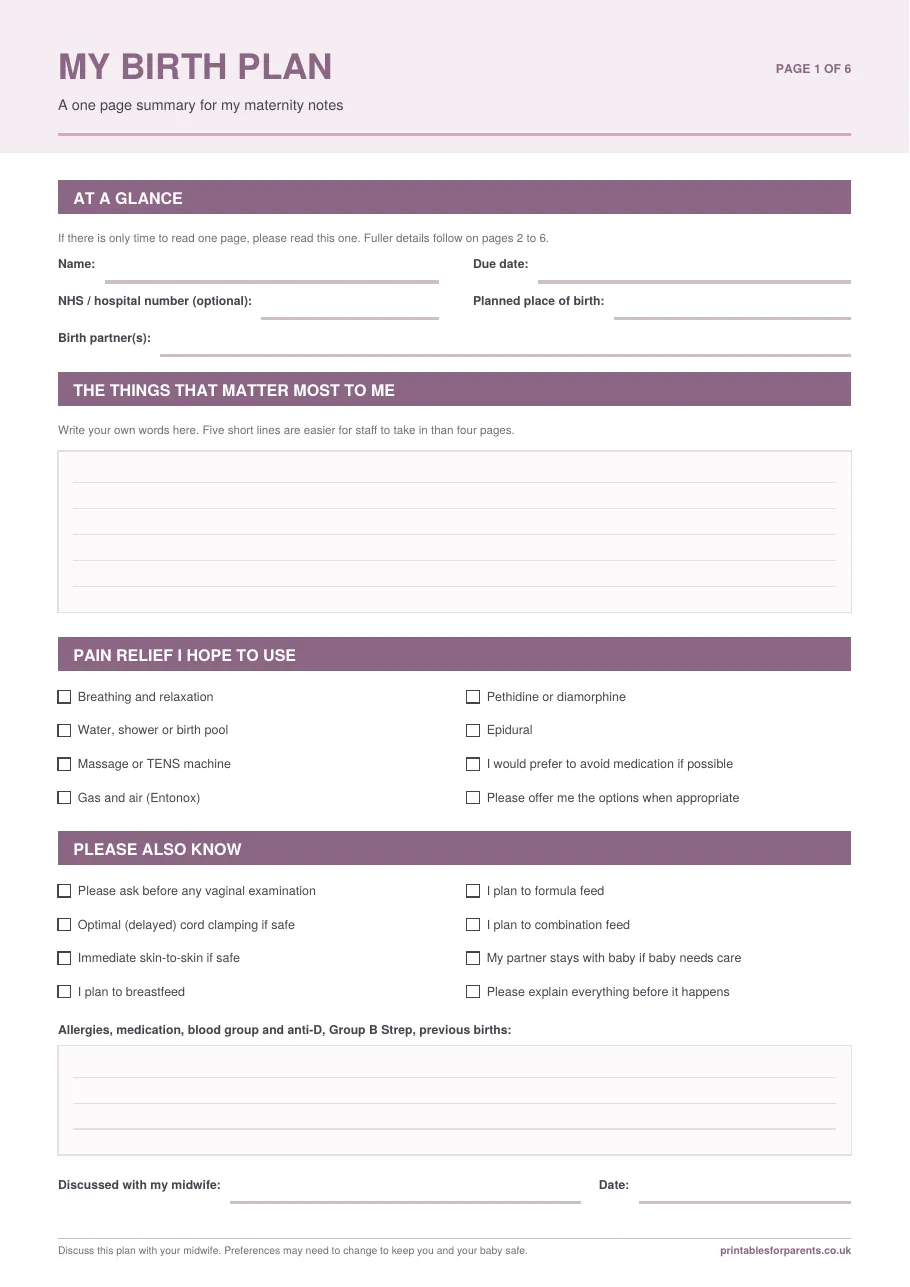
- Keep it short at the front. Staff in a busy unit will read one page. Put your non negotiables there and let the detail follow.
- Discuss it with your midwife and get it into your maternity notes.
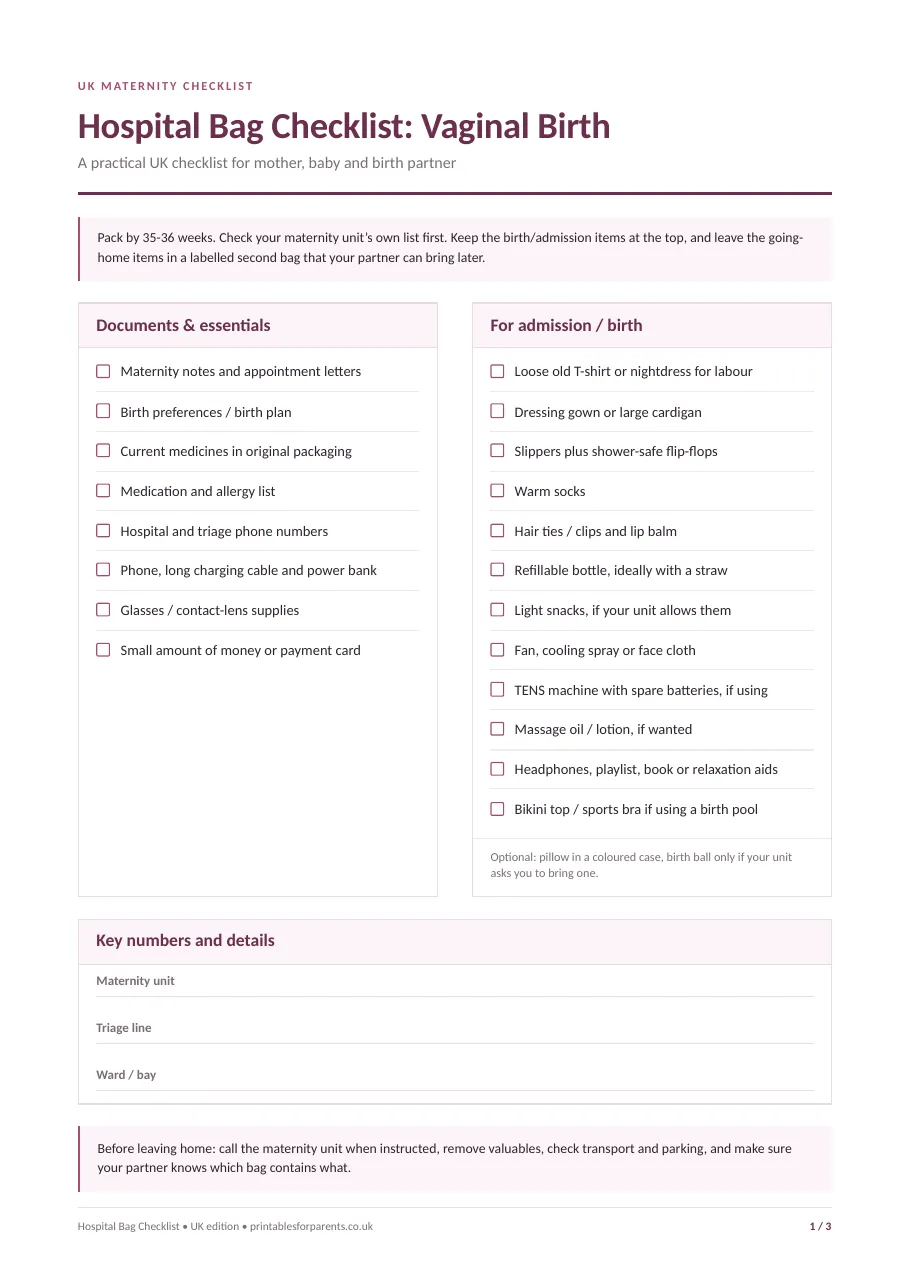
- Print two copies, one for the notes and one for the hospital bag, and make sure your birth partner has read it. They’re the one who will be quoting it back at three in the morning.
- Date it, so anyone reading knows it’s current.
Where to read more
- NHS: How to make a birth plan (nhs.uk) and NHS Start for Life: What to include in your birth plan. The plain English starting point.
- NICE guideline NG235, Intrapartum care (nice.org.uk). The clinical guidance your care is based on, including the place of birth tables above.
- NICE guideline NG207, Inducing labour (nice.org.uk). Worth reading before any induction conversation.
- NHS Maternity Statistics (digital.nhs.uk). Annual figures for England, including caesarean and onset of labour rates.
- Birthplace in England study (Brocklehurst et al., BMJ, 2011). The research behind the place of birth figures.
- Birthrights (birthrights.org.uk). The UK charity for your rights in maternity care, with free factsheets in 20 languages.
- NCT (nct.org.uk) and Tommy’s (tommys.org). Practical, well sourced parent facing guides.
- RCOG patient information (rcog.org.uk). Leaflets on assisted birth, caesarean and more.
- AIMS (aims.org.uk). Independent, campaigning, and very good on informed choice.
Ready to write yours? The free My Birth Plan template covers everything in this guide, including the induction and caesarean sections, with a one page summary at the front for the staff caring for you.
This guide is general information, not medical advice. Your midwife or doctor knows your history and your local service, so please discuss your plan with them.
Common questions
Do I have to write a birth plan?
No. The NHS is clear that a birth plan is optional, that your midwife will help you write one if you want it, and that you can change your mind about any part of it at any point. Plenty of people never write one.
What if none of it happens?
That's extremely common and it doesn't mean the plan failed. Most of the value is in the thinking and the conversation with your midwife beforehand. Write an if section covering induction, assisted birth and caesarean, and the plan keeps working even when the day doesn't follow it.
When should I write it?
Before 37 weeks, and earlier if you're expecting twins. That gives you time to discuss it at an appointment and get it into your maternity notes rather than producing it for the first time in triage.
How long should a birth plan be?
Keep the front page to one side of paper. Staff in a busy unit will read one page reliably and four pages rarely, so put the things that matter most at the top and let the detail follow behind.
Can I refuse something that's recommended?
Yes. Nothing can be done to you without your consent, and you're entitled to be told the benefits, the risks, the alternatives and what happens if you wait. Asking those questions isn't being difficult, and a good midwife will welcome them.